
RESEARCH & KNOWLEDGE TRANSFER
CASCADE 2.2
Climaticus partners with IrBEA on CASCADE 2.2, which explores the valorisation of horticultural residues through cascade pathways.
- Authored by
- Katherine Casey
- Published by
- Climaticus
- Published
CASCADE 2.2 is an Interreg North-West Europe project working on the valorisation of horticultural residues through cascade pathways. The project develops practical tools and tests regional pathways for turning residues from fruit, vegetable and flower production into higher-value uses.
The work brings together partners across Belgium, Germany, France, Ireland and the Netherlands. It focuses on collaborative development, regional testing and digital support for circular resource use.
VALORANT framework
Improving processes for efficient recovery of value-added products from horticultural residues in North-West Europe.
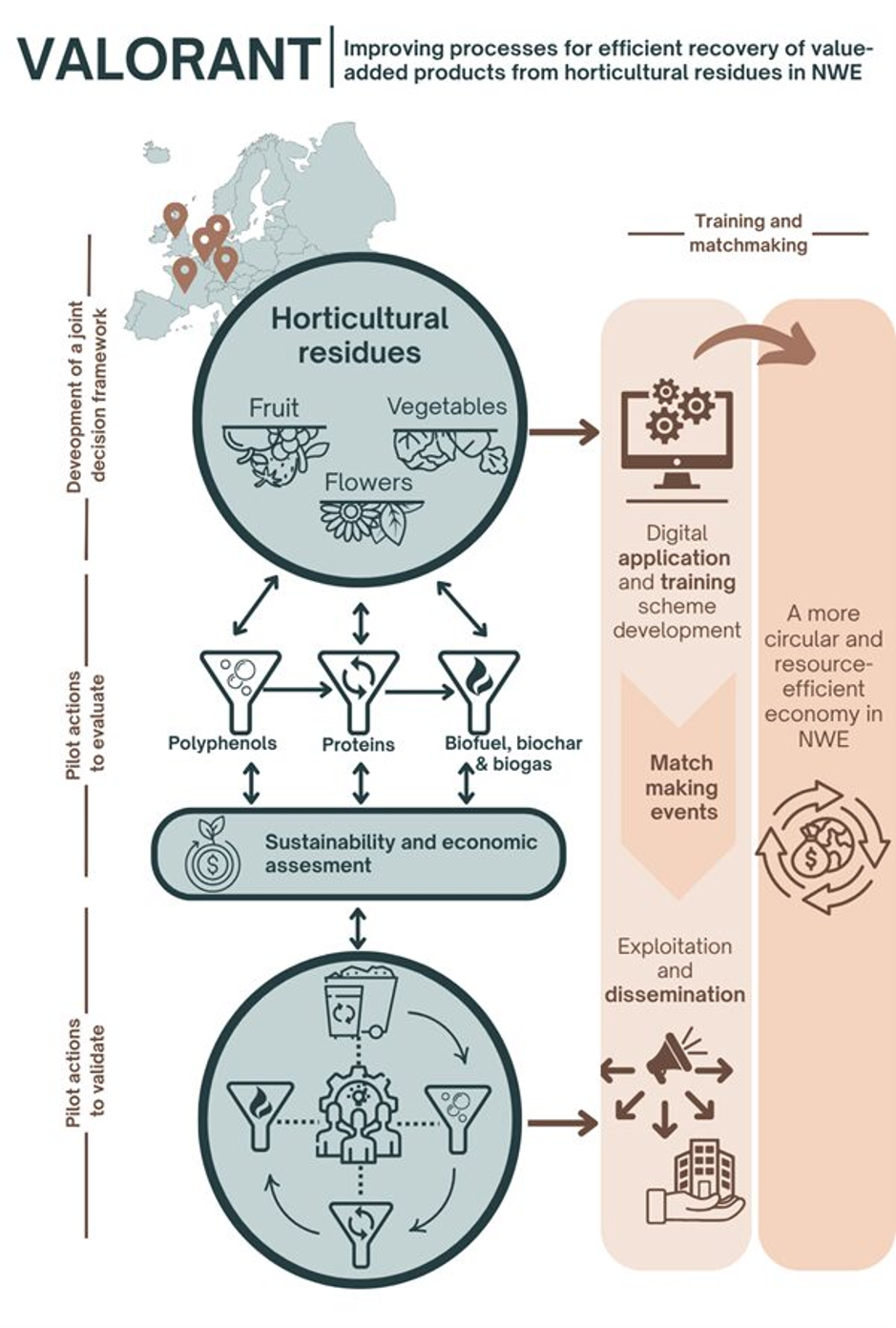
- Development of a joint decision framework.
- Pilot actions to evaluate cascade pathways.
- Pilot actions to validate regional applications.
- Training and matchmaking.
- Horticultural residues: fruit, vegetables and flowers.
- Polyphenols, proteins, biofuel, biochar and biogas.
- Sustainability and economic assessment.
- Digital application and training scheme development.
- Matchmaking events, exploitation and dissemination.
- A more circular and resource-efficient economy in North-West Europe.
Project aims
The project aims to develop a Joint Decision Framework to help farmers, processors and industry identify the best route for a given residue stream. It takes account of residue type, composition, regional availability, seasonality, market potential, processing capacity and environmental and economic performance.
It also pilots cascade pathways for horticultural residues, including apple, pear, carrot, strawberry, grape, lettuce, chrysanthemum and gerbera. These pilots move through polyphenol extraction, protein recovery and bioenergy generation.
The project also builds capacity through training, workshops, webinars and a digital decision-support tool integrated into the BioBoost platform.
IrBEA’s role
IrBEA contributes bioenergy expertise, coordinates the Irish pilot, supports life cycle assessment and costing, and helps deliver workshops and webinars for stakeholders.
It also leads communication and outreach so that national stakeholders, industry members and policymakers can access the project’s findings and tools.
Climaticus involvement
Climaticus contributes to CASCADE 2.2 through research on governance, market shaping, value chains and stakeholder engagement. This work aligns with our wider interest in circular bioeconomy transition, ownership and value capture.
Our role connects the project’s technical ambition with the social and organisational questions that shape whether circular pathways can work in practice.
What makes it distinctive
CASCADE 2.2 combines polyphenol extraction, protein production, biochar, biogas and biofuel pathways within a single cascade model. It also links those pathways to a digital decision-support tool and to region-specific validation pilots.
That combination moves beyond single-output solutions and tests how multiple value streams can be organised within a practical circular system.
Expected impact
By the end of the project, CASCADE 2.2 aims to enable at least 43 businesses and operators to valorise horticultural residues. It also aims to demonstrate sustainable cascade chains for eight residue types, deliver a functioning digital JDF platform and strengthen transnational cooperation for circular economy adoption.
Project basics
- Programme: Interreg North-West Europe.
- Priority: Transition towards a place-based circular economy.
- Duration: 43 months.
- Total budget: €4,389,735.80.
- Countries involved: Belgium, Germany, France, Ireland and the Netherlands.
Collaborate on the research.
We welcome contact from researchers, PhD candidates, academic partners and project teams working on the circular bioeconomy, cascade valorisation, life cycle assessment and horticultural residue streams. Get in touch to explore joint publications, pilot participation or knowledge exchange.