
Ireland’s rural communities are the epicentre of the just transition. The national plans for energy sovereignty will be won or lost in their townlands. Current thinking reimagines these communities as decision makers, beneficiaries, and partners for the working life of a plant. A just transition is bound by the commitments made in the planning process. The Irish government has an opportunity to take a holistic approach, encouraging the development its plans require while supporting the citizens who will bear the cost of those plans.
Ireland imports around 80% of its natural gas through two subsea interconnectors from Great Britain, and the depleting Corrib field supplies most of the remainder (Gas Networks Ireland, 2025). Gas meets roughly 30% of the State’s primary energy demand and generates more than 40% of its electricity, and Eolas magazine reported in May 2026 that Corrib has, at best, a further ten years of production (Gas Networks Ireland, 2025; Eolas, 2026). Ireland’s vulnerability is compounded by the fact that no nitrogen fertiliser is manufactured in Ireland, and Irish suppliers remain price-takers in a global market in which nitrogen fertiliser prices track the price of natural gas, its main feedstock and largest production cost (Department of Agriculture, Food and the Marine, 2022; Joint Committee on Agriculture, Food and the Marine, 2022). Irish farmers bought 1.4 million tonnes of mineral fertiliser in the 2025 crop year, a volume of product carrying almost 350,000 tonnes of nitrogen, every tonne of it imported, and in the 2025 calendar year some 317,000 tonnes of fertiliser product, measured by gross weight rather than by nitrogen content, arrived from the Middle East alone. In 2022, Russia was the largest single source of the fertiliser Ireland imported, and although its share fell to about 2% in 2023 and 2024, Ireland still spent between €518 million and €1.1 billion a year on imported fertiliser, drawn mainly from other EU states, North Africa, Norway and the United Kingdom (Figure 1). All of this indicates that Ireland’s food system is acutely exposed to supply chain turmoil (Central Statistics Office, 2025; Agriland, 2026). On 29 March 2026 the European Commission issued a Detailed Opinion blocking a core provision of Ireland’s proposed Renewable Heat Obligation, the multiplier that would have counted Irish-produced biomethane at a premium within Ireland’s own heat market (ifac, 2026; Irish Farmers Journal, 2026a).
Figure 1. Where Ireland’s fertiliser imports came from, by value, 2022 to 2025
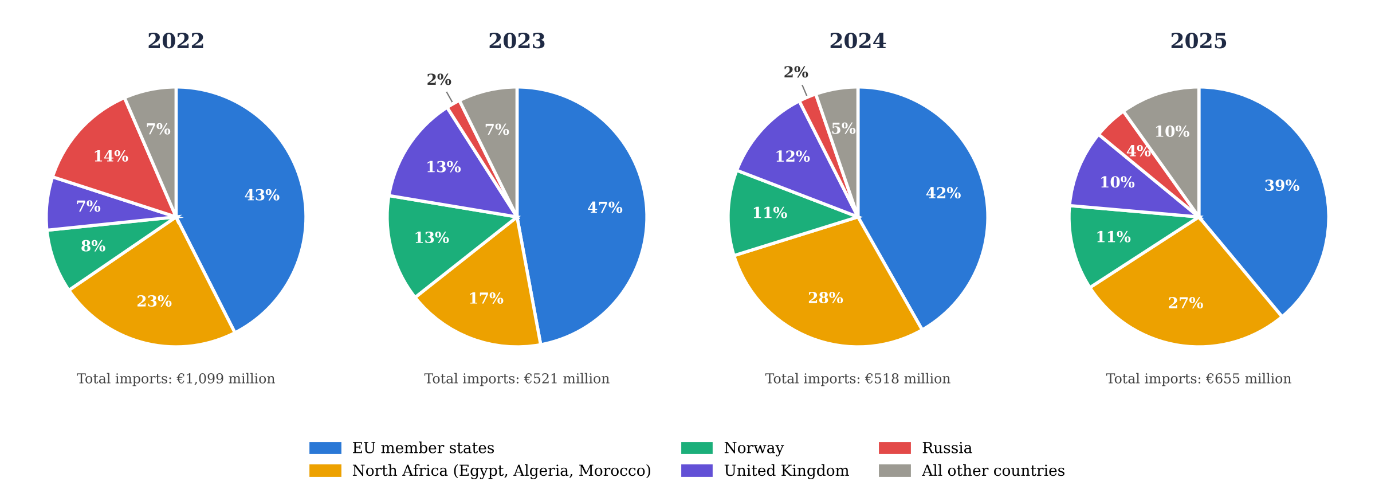
Sources: UN Comtrade, via World Bank WITS, Ireland imports of HS 31 fertilisers by partner country, 2022 to 2025; converted from US dollars at ECB annual average rates (European Central Bank, 2026). Countries are recorded as the country of consignment, so the EU share includes product shipped through ports such as Antwerp and Rotterdam. Percentages may not sum to 100% owing to rounding.
As European gas prices surged in 2021 and 2022, Irish fertiliser prices rose by 200% to 250% on their 2021 level, the cost of fertiliser to Irish agriculture doubled from €606 million to €1.2 billion, and by March 2023 food and non-alcoholic beverage prices were 13.1% higher than a year earlier (Teagasc, 2022; Department of Agriculture, Food and the Marine, 2023; Central Statistics Office, 2023). Nor is it fertiliser alone that these increases strike: in 2022 electricity prices rose by 62.7%, gas by 86.5% and home heating oil by 39.9%, a heavy burden in rural areas, where many homes still heat with oil (Central Statistics Office, 2022).
Given the degree of this dependence, we would argue that the case for indigenous renewable energy concerns sovereignty first and decarbonisation second. The public shares at least the premise, since in a national survey of 1,154 people, 65% believed that Ireland is too reliant on foreign energy (Cronin, Cummins and Wolsztynski, 2021). A country that produces more of its own gas, electricity and fertiliser reduces its exposure to the tumultuous import markets on which it currently depends. Yet national fuel sovereignty is built locally, in rural townlands, on rural roads, beside rural homes.
Four plans: A Single Objective
The State’s ambition for Irish-produced energy is set out across four plans, summarised in Table 1: the National Biomethane Strategy (2024), which commits Government to supporting up to 5.7 TWh of indigenously produced biomethane a year by 2030; the Climate Action Plan 2025, which retains targets of 9 GW of onshore wind, 8 GW of solar and at least 5 GW of offshore wind; the Future Framework for Offshore Renewable Energy (2024), which extends the offshore horizon to at least 37 GW by 2050; and BioScale 2030, the first National Bioeconomy Strategy, which presents the bioeconomy as a means of reducing fossil imports, strengthening national resource security and contributing to a just transition (Department of the Environment, Climate and Communications and Department of Agriculture, Food and the Marine, 2024; Mason Hayes & Curran, 2025; Department of the Environment, Climate and Communications, 2024; Department of Climate, Energy and the Environment and Department of Agriculture, Food and the Marine, 2026).
Table 1. What the 2030 targets mean on the ground: estimated number of new energy projects, by technology
| Plan | Target | Estimated new projects needed by 2030 |
|---|---|---|
| National Biomethane Strategy (May 2024) | Up to 5.7 TWh a year, about a tenth of national gas demand; two plants injecting about 75 GWh a year as of March 2026, a baseline that preceded the late-summer 2026 grid connections at Huntstown, Nobber and the Mitchelstown Central Grid Injection facility | 150 to 200 anaerobic digestion plants (official estimate) |
| Onshore wind | 9 GW; just over 5 GW installed in January 2025 | About 65 to 135 onshore wind farms |
| Solar | 8 GW; more than 2 GW installed by November 2025 | About 80 to 120 solar farms, plus rooftop systems |
| Offshore wind | At least 5 GW (20 GW by 2040, at least 37 GW by 2050); only the 25 MW Arklow Bank pilot operating | About 6 to 7 offshore wind farms by 2030, including Tonn Nua (about 900 MW); about 30 to 40 by 2050 |
| Total | – | About 300 to 450 major projects by 2030* |
Sources: Department of the Environment, Climate and Communications and Department of Agriculture, Food and the Marine (2024); Department of the Environment, Climate and Communications (2024); Mason Hayes & Curran (2025); Irish Times (2025); Cornwall Insight (2026); Seanad Éireann (2024); William Fry (2026); Irish Examiner (2026); Gas Networks Ireland (2026). *Project numbers for wind and solar are the author’s estimates of what the targets would require, not forecasts of what will be built. They rest on the capacity still to be built and on typical project sizes (30 to 60 MW for onshore wind, about 50 MW for utility-scale solar and about 1 GW for offshore wind); the solar range assumes that rooftop and other non-utility-scale installations supply between none and about a third of the outstanding capacity. The biomethane figure is the Strategy’s own estimate.
Taken together, the 2030 targets translate into an estimated 300 to 450 new wind farms, solar farms and anaerobic digestion plants (Table 1), or, across the roughly 215 weeks between November 2026 and the end of 2030, between one and two new projects every week. Nearly every onshore project will need a host community, thus the transition is in the hands of Ireland’s rural communities. Perhaps it is time they talk terms.
A Bioeconomy that Joins the Dots
Cumulatively these plans represent a system designed for rural Ireland. Anaerobic digestion breaks down manures, slurries and food and agricultural residues to produce a methane-rich biogas, which can be upgraded to biomethane for the gas network, and a nutrient-rich digestate that farmers can use as fertiliser where it is managed and applied appropriately (Monaghan County Council, 2025; SEAI, 2020), and unlike solar power its production runs continuously (Irish Farmers Journal, 2026b). In County Monaghan, where approximately 255,217 tonnes of poultry manure arise each year and much of it has historically been transported out of the county, a local digestion plant would localise the process (Anglo-Celt, 2026). Not building the plants carries an opportunity cost: foregoing the jobs, feedstock contracts and new income that BioScale 2030 promises farmers, foresters and fishers.
BioScale 2030 places food and feed security, waste prevention and higher-value material uses ahead of energy in its principle of cascading use, accepts bioenergy and biomethane where they support circularity, energy security and climate objectives, and proposes to make best available cascading technologies a condition of State funding for anaerobic digestion (Department of Climate, Energy and the Environment and Department of Agriculture, Food and the Marine, 2026), so the case for a plant rests increasingly on the whole system of outputs it serves. However, although the benefits of a strong bioeconomy accrue nationally, its lorries, turbines, panels and pylons arrive locally. The crucial question of who carries this burden, and on what terms, is one of justice.
Inevitable but Negotiable
Irish law commits the State to climate neutrality by 2050, and under European law renewable energy projects now benefit from a presumption that they serve the overriding public interest, which carries weight in planning and environmental assessment, rendering the transition inevitable (Climate Action and Low Carbon Development (Amendment) Act 2021; William Fry, 2026). Inevitability, however, cuts both ways: it can be invoked to foreclose local debate, or it can embolden host communities to set their own terms. Wielded by government or industry, it reduces local objection to an obstacle to be managed (Bailey and Darkal, 2018). ‘Green’ extractivism exploits the climate crisis to prise open new markets and enlists sustainability to sanction the appropriation of land, landscape and resources (Dunlap, Verweijen and Tornel, 2024).
Ireland is more than familiar with this extractive pattern. Since the 1960s, rural Ireland has absorbed the toxic externalities of multinational chemical, pharmaceutical and technology industries, and, as a nation, we ought to learn from that history: the struggles those places waged over land, livelihood, health and the culture of place should inform how the transition is designed (Bresnihan and Brodie, 2024). Renewable energy is, without qualification, rooted in place, drawing on land, landscape, roads, the sea and slurry, and it inherits the same unsettled ledger of who gains and who bears the cost.
The idea of a just transition emerged in the North American trade union movement as a way of reconciling environmental and economic goals in particular regions and communities, and researchers have since proposed refocusing it on distributional, procedural and restorative justice, meaning a fair sharing of benefits and burdens, the inclusion of affected communities in decision-making, and the repair of past harms (Eder, Kreinin and Wukovitsch, 2023). Energy justice theorists Jenkins and colleagues (2016) identify distributional, procedural and recognition justice as its core tenets, and Sovacool and colleagues (2019) summarise them as the sharing of costs and benefits, due process, and attention to vulnerable groups. Irish law recognises the principle: the Climate Action and Low Carbon Development (Amendment) Act 2021 requires regard to a just transition that supports persons and communities negatively affected, and the national Just Transition Framework commits the State to social dialogue so that impacted communities are ‘empowered and are core to the transition process’ (Oireachtas, 2024).
Setting terms requires a process, and the character of that process determines whether inevitability emboldens a community or silences it. Residents have a claim to shape the decisions that determine how a plant is built beside them, and that claim rests on principle before it rests on any advantage it brings a developer. A process becomes fair when residents influence the decisions that matter to them, when the choices put before them remain genuinely open, and when the developer gives its reasons where it sets a preference aside. Fairness understood in this way survives disagreement, because a community may still object at the end of a fair process, and the process remains fair. A developer who treats that objection as an obstacle to be managed forfeits the fairness of the process, whatever consultation it records.
Inclusive Design: Common Ground for Developers and Communities
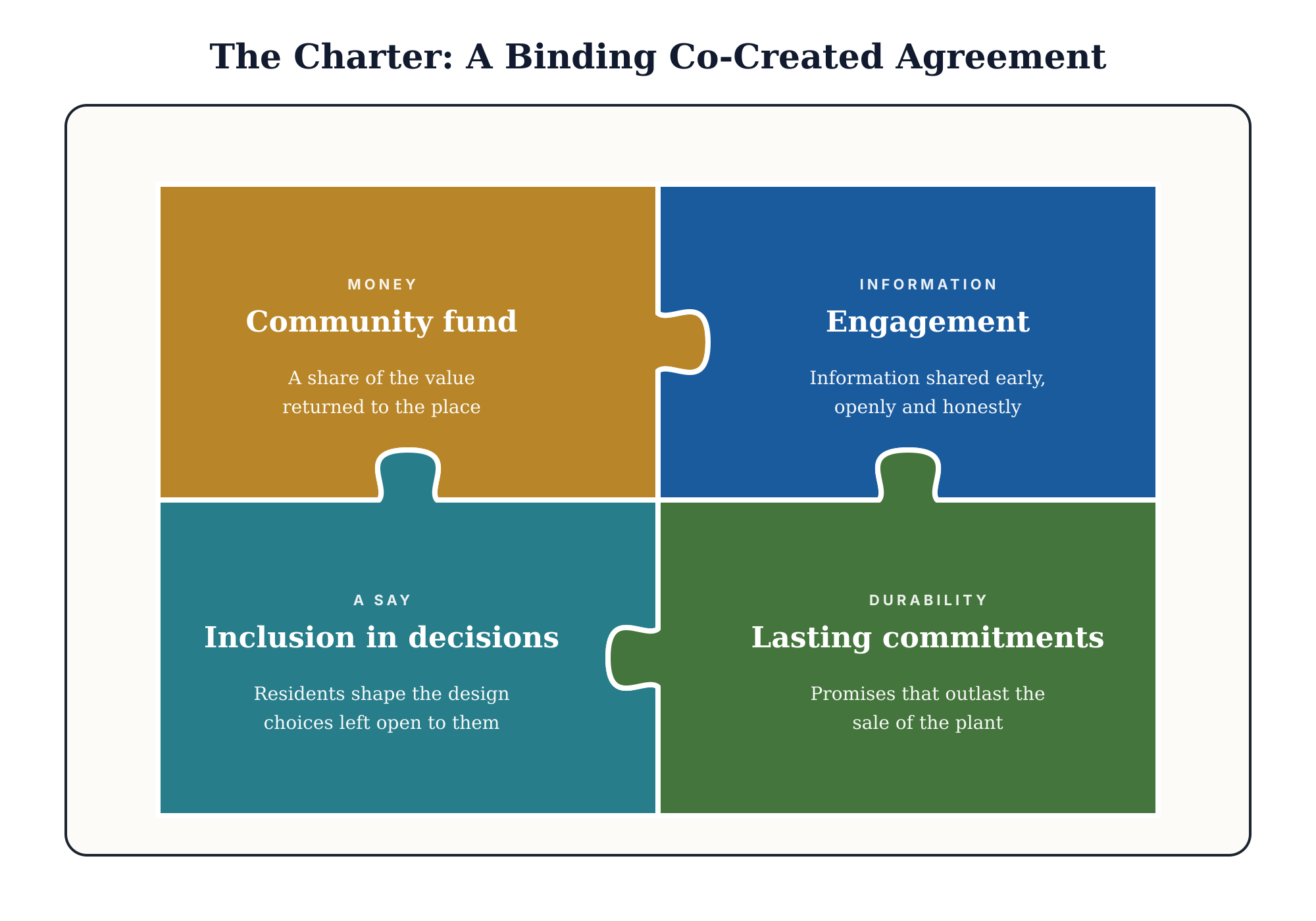
Figure 2. The pieces of the jigsaw: a community fund is one piece, and the other three concern information, a say in decisions and commitments that last, which a charter writes down
Perhaps the most overlooked piece of this jigsaw is inclusive decision making. Communities that feel powerless, excluded from any influence over a project, are strongly motivated to oppose it (Power et al., 2023). Perlaviciute (2021) distils four standards for participation from the literature, namely dialogue, decision-making power, diversity and deliberation, and she warns that where people want to take part only late in decision-making, or not at all, the result can be what she calls fake participation, which may lower acceptance. The State has now adopted the same reasoning for the bioeconomy. BioScale 2030 names land use, traffic and logistics, visual amenity, odour and noise as the effects on which durable community acceptance turns, and it observes that stronger support is possible where communities have early and meaningful engagement in decision making, where primary producers participate through cooperative ownership, and where value is captured locally and benefits are shared transparently (Department of Climate, Energy and the Environment and Department of Agriculture, Food and the Marine, 2026).
Inclusion in design stops short of handing a project to the community wholesale. Design resolves only some value conflicts, because developers choose from equipment already on the market and because political and financial limits close off other accommodations, so participation in detailed design carries a bounded scope (van der Waal et al., 2020; Power et al., 2023). One way to strike the balance is a defined degree of flexibility on the developer’s side: a clear statement, made before the design is fixed, of which decisions are open to residents, which are closed and why, followed by genuine options on the open decisions. Research into developer practice recommends precisely this clarity about what remains negotiable, finds that engagement and benefit-sharing work best when they are tailored to each community rather than following one size fits all, and finds that the ‘decide–announce–defend’ pattern, in which complete plans arrive with minimal opportunity for feedback, damages relationships, while most companies can identify decisions a community could make, among them construction traffic routes, the number and location of turbines, the design of benefit-sharing programmes and the conduct of engagement itself (Hall et al., 2017). For an anaerobic digestion plant, the open decisions might include haulage routes and delivery hours, the position of buildings and tanks within the site, screening and landscaping, odour abatement, the mix of feedstocks, the design of any community amenity, and the formula and governance of the fund itself. Participatory approaches are recommended in identifying community needs and aspirations, in designing amenities and in solving problems of disruption jointly (Power et al., 2023).
Table 2. Where residents shaped the project: five cases
| Case | The process | What residents shaped |
|---|---|---|
| Middelgrunden, Copenhagen (offshore wind) | A public hearing on the 1997 proposal, with visualisation software supporting the debate | The layout: 27 turbines in three rows became 20 in a single curve, and residents later co-owned half the farm through a cooperative |
| Brake, Lower Saxony, Germany (two wind parks) | Information events, a site inspection, a hotline and consultation hours | An agreed package: a height cap, a setback, free building surveys, blinds for shadow flicker and property-value compensation |
| Biométhane de l’Aisne, France (biogas) | Siting and logistics shaped with farm bodies; the industry’s own account, to be read as such | The plant stands away from the villages and the prevailing winds, and underground pipes carry digestate, reducing lorry traffic |
| Poolbeg and Knockharley, Ireland (waste-to-energy and landfill) | Liaison committees required by planning conditions, with an independent chair and community, council and operator seats | Poolbeg’s committee administers the fund and publishes audited accounts; Knockharley’s decides which environmental projects go ahead |
| Stillwater, Montana, United States (mining) | A binding good neighbour agreement: oversight committees, company-funded independent audits and community inspections | Commitments that bind later owners, surviving sales of the mine |
Sources: Middelgrunden Wind Turbine Cooperative (2005); PETUS (n.d.); Haney and Pollitt (2013); Reitz, Goshen and Ohlhorst (2022); European Biogas Association (2025); An Bord Pleanála (2002; 2007); Dublin City Council (2024); World Resources Institute (2024).
A fair process does not, however, ask developers to act against their own interests: failure to gain and keep local acceptance quickly leads to conflict, delay and additional cost, a developer’s reputation travels with it to every new project and to every request to extend or repower an existing one (Power et al., 2023), and the cases gathered in Table 2, from the Middelgrunden cooperative to the Stillwater good neighbour agreement, reportedly benefited the developers who opened part of their projects to local influence or benefit (Haney and Pollitt, 2013; World Resources Institute, 2024). Indeed, the State has now written several of these ideas into its own policy. On 21 October 2026 it launched BioScale 2030, and under Action 5.3.1 it commits itself to developing, during 2027 and 2028, a social and community value framework for bioeconomy projects, under which developers would undertake to include the local community from the earliest concept stage and to follow a standardised approach to inclusive engagement and benefit-sharing (Department of Climate, Energy and the Environment and Department of Agriculture, Food and the Marine, 2026).
Community funds, the next jigsaw piece, already exist in Irish policy. Every project supported under the Renewable Electricity Support Scheme must pay €2 per MWh into a community benefit fund, register the fund with the SEAI and report on it annually (SEAI, 2026; Mason Hayes & Curran, 2025b). In Mayo, the community fund attached to the Oweninny wind farm, established as a condition of planning consent, made significant allocations to local groups in 2021 alone, and its development, governed through a board and an evaluation committee that both include community members and administered for its second phase by an independent local development company, offers one of the more fully developed Irish models for what a fund can become (Mayo County Council, 2021; 2025; Oweninny Power 2 DAC, 2026a; 2026b). Funds of this kind help to give a transition its distributive justice.
A fund is most surely fortified by its accompaniments, the inclusive design that precedes it and the accessible transparency that girds the project throughout the working life of the plant, the details of which are captured in a binding charter between host community and plant operator. Anaerobic digestion currently falls outside the mandatory fund, which attaches only to electricity projects that win RESS auctions (Oireachtas, 2023), and the commitment made at Drum, County Monaghan, is all the more welcome for it: the municipal district minutes record the developer’s promise of an annual community fund for the digester, which received conditional planning approval from Monaghan County Council on 29 October 2026, a voluntary undertaking that may be among the first of its kind for an Irish biogas plant, and although its amount, duration and governance remain to be settled, the promise is a solid first step on which a charter could build (Monaghan County Council, 2025; 2026).
There are some avoidable pitfalls associated with community funds. Between about 10% and 25% of residents near Irish wind farms, depending on the stage of development, said that a community benefit fund would reduce their acceptance of a project, and non-monetary benefits such as new amenities and infrastructure improved acceptance more than payments at every stage (Power et al., 2023). MacDonald, Glass and Creamer (2017), studying a commercial wind farm in central Scotland, found that residents regarded the benefit package as a vehicle for winning planning permission, and that a poor engagement process had compromised whatever good the fund might have done. Their findings echo Aitken (2010, p. 6073), who found it ‘was not possible to separate’ residents’ judgements of a benefit package from their judgements of the decision-making that preceded it. Perceived benefits, perceived costs and trust in the operator all shaped acceptance of Swiss biogas plants (Soland, Steimer and Walter, 2013). Furthermore, the beneficiaries of a fund are not necessarily those who carry its burdens, since the farmers who supply a plant, the landowners who host it, the near neighbours who live beside it and the groups that receive its grants may be four different constituencies; indeed, payments confined to turbine hosts have created financial winners and losers within small rural communities (Hall et al., 2017).
Table 3. Five funds: where the money comes from and how it is distributed
| Case | How the fund arises | How the money is distributed |
|---|---|---|
| Oweninny, Mayo, Ireland (wind) | Phase 1: a condition of planning consent; Phase 2: the mandatory RESS fund | Grants to local groups: a Council-managed board and evaluation committee with elected community members for Phase 1; an independent local development company and a committee of ten community members for Phase 2, nearest communities first |
| Poolbeg, Dublin, Ireland (waste-to-energy) | A community gain fund written into the planning permission; the EPA licence separately requires the liaison committee | The liaison committee administers the fund and publishes annual reports with audited accounts |
| Yellow River, Offaly, Ireland (wind) | The mandatory RESS fund | A community fund committee allocates; the developer engaged a local development company to co-facilitate and consulted on a community action plan before the fund opened |
| Denmark (wind, national schemes) | Statute: compensation for lost property value, shares for neighbours and a municipal green fund, later a production bonus and a sale option | Paid directly to neighbours and into municipal pools |
| North Frisia, Germany (largely community-owned wind) | Municipal land and trade taxes on the turbines | The income stays in the municipal budget where the plant stands, and community foundations led by local citizens give it a long-term footing |
Sources: Mayo County Council (2021; 2025); Oweninny Power 2 DAC (2026a; 2026b); Western People (2026); An Bord Pleanála (2007); Environmental Protection Agency (2023); Dublin City Council (2024); SSE Renewables (2023; 2024); Rambøll Management Consulting (2022; 2025); Süsser and Kannen (2017).
Table 4. When benefits are required: what the evidence shows
| Setting | Requirement | Finding |
|---|---|---|
| Ireland, wind | Voluntary pledge of €2/MWh in 2018; mandatory for RESS projects from the first auction in 2020; binding Rulebook since May 2025 | Only RESS projects must pay; Mayo’s chief executive judged that companies will not pay more than they are required to |
| Experiment, United Kingdom | Residents told that community benefits were a policy requirement | Significantly higher support for the wind farm, even when the charge of bribery had been made salient |
| Denmark | Statutory compensation, bonus, sale-option and green-fund schemes | No significant effect on existing neighbours’ support; small effects for possible future neighbours; local politicians value the schemes as a safety net |
| North Frisia, Germany | Municipal land and trade taxes from the turbines | Most interviewees regarded benefits as fairly and collectively distributed |
Sources: IWEA (2018); Oireachtas (2023); Mason Hayes & Curran (2025b); Western People (2026); Walker, Russel and Kurz (2017); Rambøll Management Consulting (2022; 2025); Süsser and Kannen (2017).
Accessible transparency, the third piece, asks more of an operator than the periodic publication of accounts. A charter can stipulate what the operator will disclose and at what cadence: the monitoring data bearing upon the nuisances residents actually encounter, odour, noise, traffic and hours of operation, published as they are gathered rather than summarised a year in arrears; the fund’s income, its allocations and the reasoning that attended any refusal; the identity of the plant’s owner and of any party to whom its obligations have passed; and the minutes of whatever body oversees the arrangement. Irish precedent for disclosure of this order already exists, since the Poolbeg licence obliges the operator to publish monitoring data online as they are recorded, together with daily and weekly summaries, and to circulate a newsletter to residents at least twice a year (Environmental Protection Agency, 2023). What distinguishes accessible transparency from transparency simpliciter is the labour it spares the resident, for information lodged in a file that must first be requested, in a format that resists reading, discharges the letter of openness while defeating its purpose.
Commitments that endure, the fourth piece, confront the plain fact that a plant will in all likelihood outlive the company that built it, since renewable energy assets change hands and a promise binding only upon the original developer expires with the sale. Irish practice supplies the instructive example at Poolbeg, where the community gain fund and its ten-member liaison committee were written into the conditions of the planning permission, and where the facility’s industrial emissions licence, reviewed and reissued as W0232-02 in October 2023, separately obliges the operator to maintain that committee, so that the obligation attaches to the plant rather than to whoever happens to own it at a given moment (An Bord Pleanála, 2007; Environmental Protection Agency, 2023; Dublin City Council, 2024). Whether a charter can acquire comparable force, and by which instrument, is a question for legal and planning experts, and a charter that leaves it unexamined offers residents a promise without a guarantor.
Completing the Jigsaw
The case for planning policy is a case for the whole jigsaw rather than for any single piece of it. A fund required on its own invites the suspicion the evidence already records; information published on its own informs no decision; and a say in design that expires once permission is granted leaves residents without recourse for the decades that follow. Planning policy could set national expectations for anaerobic digestion as well as wind and solar: a pre-application statement of which design decisions remain open to residents and what changed as a result, a community fund that lasts for the life of the plant whatever the subsidy position, information that residents can find and interrogate, and commitments that attach to the plant rather than to whoever owns it.
BioScale 2030 moves part of the way towards that position, yet its framework remains voluntary and establishes no mechanism for checking whether a developer honours what it promised the community hosting its plant (Department of Climate, Energy and the Environment and Department of Agriculture, Food and the Marine, 2026), so a charter of the kind this article proposes could serve as a working example of what such a framework might contain before the official version arrives. We would go further and predict, and it is a prediction rather than a certainty, that funds and inclusion in design will follow the same road for anaerobic digestion that they travelled for wind, from voluntary practice into policy.
We have the resources, the land and the policy commitment to build the plants our plans require, and community funds can help to make that building fairer, returning income to the places that host the infrastructure and supporting the farmers who supply it. Ireland’s plans for energy sovereignty will stand or fall locally, and above all on one question: whether communities can hold a plant to its promises over its whole operating life.
References
Agriland (2026) ‘Four years, two fertiliser shocks: global conflicts hit Irish farmers’. https://www.agriland.ie/farming-news/four-years-two-fertiliser-shocks-global-conflicts-hit-irish-farmers/
Aitken, M. (2010) ‘Wind power and community benefits: challenges and opportunities’, Energy Policy, 38(10), pp. 6066–6075. https://doi.org/10.1016/j.enpol.2010.05.062
An Bord Pleanála (2002) Order PL17.125891, Knockharley landfill, County Meath, condition 5. https://epawebapp.epa.ie/licences/lic_eDMS/090151b28071a433.pdf
An Bord Pleanála (2007) Order 29S.EF2022, Dublin Waste to Energy, conditions 2 and 3, as reproduced by Dublin City Council in Community Gain Liaison Committee: planning and licence conditions. https://www.dublincity.ie/sites/default/files/2021-03/cglf-planning-conditions.pdf
Anglo-Celt (2026) ‘Plans lodged to build digester near Drum’. https://www.anglocelt.ie/?p=128581
Bailey, I. and Darkal, H. (2018) ‘(Not) talking about justice: justice self-recognition and the integration of energy and environmental-social justice into renewable energy siting’, Local Environment, 23(3), pp. 335–351. https://doi.org/10.1080/13549839.2017.1418848
Bresnihan, P. and Brodie, P. (2024) ‘From toxic industries to green extractivism: rural environmental struggles, multinational corporations and Ireland’s postcolonial ecological regime’, Irish Studies Review, 32(1), pp. 93–122. https://doi.org/10.1080/09670882.2024.2304946
Central Statistics Office (2022) Consumer Price Index December 2022. https://www.cso.ie/en/releasesandpublications/ep/p-cpi/consumerpriceindexdecember2022/
Central Statistics Office (2023) Consumer Price Index March 2023. https://www.cso.ie/en/releasesandpublications/ep/p-cpi/consumerpriceindexmarch2023/
Central Statistics Office (2025) Fertiliser Sales 2025. https://www.cso.ie/en/releasesandpublications/ep/p-fsa/fertilisersales2025/
Climate Action and Low Carbon Development (Amendment) Act 2021 (No. 32 of 2021). https://www.irishstatutebook.ie/eli/2021/act/32/enacted/en/html
Cornwall Insight (2026) ‘Energy policy progress in Ireland and Northern Ireland: looking back at 2025’. https://cornwall-insight.com/thought-leadership/blog/energy-policy-progress-in-ireland--northern-ireland-looking-back-at-2025
Cronin, Y., Cummins, V. and Wolsztynski, E. (2021) ‘Public perception of offshore wind farms in Ireland’, Marine Policy, 134, 104814. https://doi.org/10.1016/j.marpol.2021.104814
Department of Agriculture, Food and the Marine (2022) Written answer on fertiliser supply, Dáil Éireann, 26 July 2022. https://www.oireachtas.ie/en/debates/question/2022-07-26/2117/
Department of Agriculture, Food and the Marine (2023) Fact Sheet on Irish Agriculture. https://assets.gov.ie/268151/30229379-b87f-4df3-8980-9051a7eef84c.pdf and https://assets.gov.ie/289345/d3a618b0-a3fa-4be8-8824-1d4eb70cf120.pdf
Department of Climate, Energy and the Environment and Department of Agriculture, Food and the Marine (2026) Bioeconomy Strategy 2026–2030. BioScale 2030: Advancing a Sustainable Bioeconomy for Ireland. Dublin: Government of Ireland.
Department of the Environment, Climate and Communications (2024) Future Framework for Offshore Renewable Energy. https://www.gov.ie/en/department-of-the-environment-climate-and-communications/publications/future-framework-for-offshore-renewable-energy/
Department of the Environment, Climate and Communications and Department of Agriculture, Food and the Marine (2024) National Biomethane Strategy. https://www.gov.ie/en/publication/d115e-national-biomethane-strategy
Dublin City Council (2024) Dublin Waste to Energy Community Gain Fund Annual Report 2023. https://www.dublincity.ie/sites/default/files/2024-10/dublin-waste-to-energy-community-gain-fund-annual-report-2023-1.pdf
Dunlap, A., Verweijen, J. and Tornel, C. (2024) ‘The political ecologies of “green” extractivism(s): an introduction’, Journal of Political Ecology, 31(1). https://doi.org/10.2458/jpe.6131
Eder, J., Kreinin, H. and Wukovitsch, F. (2023) ‘Introduction: Just transition, a global perspective’, Journal für Entwicklungspolitik, 39(3/4), pp. 4–14. https://doi.org/10.20446/jep-2414-3197-39-3-4
Environmental Protection Agency (2023) Industrial Emissions Licence Register No. W0232-02, Dublin Waste to Energy Limited, Pigeon House Road, Poolbeg, Dublin 4: Recommended Determination, condition 2.2.2.12 (Public Awareness and Communications Programme), requiring the licensee to maintain a Community Liaison Committee; licence issued 16 October 2023, replacing W0232-01 of 1 December 2008. https://epawebapp.epa.ie/licences/lic_eDMS/090151b28086bb8f.pdf
Eolas (2026) Interview with the chief executive of Gas Networks Ireland. https://www.eolasmagazine.ie/?p=46609
European Biogas Association (2025) Beyond the plant: aligning biogas projects with community needs. Brussels: European Biogas Association, October.
European Central Bank (2026) Euro foreign exchange reference rates, annual averages, 2022–2025. https://www.ecb.europa.eu/stats/policy_and_exchange_rates/euro_reference_exchange_rates/html/eurofxref-graph-usd.en.html
Gas Networks Ireland (2025) Strategic Gas Emergency Reserve. https://www.gasnetworks.ie/about/projects/strategic-gas-emergency-reserve
Gas Networks Ireland (2026) ‘Taoiseach opens new €32m biomethane facility boosting Ireland’s growing renewable gas industry’, 2 October. https://www.gasnetworks.ie/corporate/news/active-news-articles/mitchelstown-cgi
Hall, N.L., Hicks, J., Lane, T. and Wood, E. (2017) ‘Evaluating community engagement and benefit-sharing practices in Australian wind farm development’, Case Studies in the Environment, 1(1), pp. 1–6. https://doi.org/10.1525/cse.2017.000521
Haney, A.B. and Pollitt, M.G. (2013) ‘New models of public ownership in energy’, International Review of Applied Economics, 27(2), pp. 174–192. https://doi.org/10.1080/02692171.2012.734790
ifac (2026) ‘A legal setback, not a strategic one: Ireland must press ahead with biomethane’. https://www.ifac.ie/news-insights/insights/a-legal-setback-not-a-strategic-one-ireland-must-press-ahead-with-biomethane
Irish Examiner (2026) ‘Ireland’s first National Bioeconomy Strategy launched’, 21 October. https://www.irishexaminer.com/farming/arid-41926904.html
Irish Farmers Journal (2026a) ‘Cracks show on State’s AD rocky roadmap’. https://www.farmersjournal.ie/amp/more/renewables/cracks-show-on-state-s-ad-rocky-roadmap-912491
Irish Farmers Journal (2026b) ‘Slurry-powered AD plant pays on NI dairy farm’. https://www.farmersjournal.ie/amp/more/renewables/slurry-powered-ad-plant-pays-on-ni-dairy-farm-926347
Irish Times (2025) ‘Revised national plan will accelerate rollout of Irish renewables’, 10 April. https://www.irishtimes.com/business/economy/2025/04/10/revised-national-plan-will-accelerate-rollout-of-irish-renewables-copenhagen-conference-told
IWEA (2018) Community Engagement: Partnership and Progress. Irish Wind Energy Association. https://www.windenergyireland.com/images/files/9660bdff3ce17339b44c78b7a6c6f624edcaf7.pdf
Jenkins, K., McCauley, D., Heffron, R., Stephan, H. and Rehner, R. (2016) ‘Energy justice: a conceptual review’, Energy Research & Social Science, 11, pp. 174–182. https://doi.org/10.1016/j.erss.2015.10.004
Joint Committee on Agriculture, Food and the Marine (2022) Debate of 19 January 2022. https://data.oireachtas.ie/ie/oireachtas/debateRecord/joint_committee_on_agriculture_food_and_the_marine/2022-01-19/debate/mul@/main.pdf
MacDonald, C., Glass, J. and Creamer, E. (2017) ‘What is the benefit of community benefits? Exploring local perceptions of the provision of community benefits from a commercial wind energy project’, Scottish Geographical Journal, 133(3–4), pp. 172–191. https://doi.org/10.1080/14702541.2017.1406132
Mason Hayes & Curran (2025) ‘Review of Climate Action Plan 2025’. https://www.mhc.ie/latest/insights/review-of-climate-action-plan-2025
Mason Hayes & Curran (2025b) ‘RESS Community Benefit Funds: new Rulebook’. https://www.mhc.ie/latest/insights/ress-community-benefit-funds
Mayo County Council (2021) ‘34 local community groups benefit from Oweninny Community Benefit Fund allocations’, 16 June. https://mayo.ie/news/oweninnycbfallocations
Mayo County Council (2025) Oweninny Community Benefit Fund Scheme 2025, Category 3. https://consult.mayo.ie/en/content/oweninny-community-benefit-fund-scheme-2025-category-3-small-scale-capital-projects-within-target
Middelgrunden Wind Turbine Cooperative (2005) Experiences from Middelgrunden 40 MW offshore wind farm. https://www.middelgrunden.dk/wp-content/uploads/2021/03/Artikel-Copenhagen-Offshore-7-Middelgrund.pdf
Monaghan County Council (2025) Minutes of the Municipal District of Ballybay-Clones, 17 November 2025. https://monaghan.ie/wp-content/uploads/2026/01/November-2025-Minutes.pdf
Monaghan County Council (2026) Planning file 26/60018. https://www.eplanning.ie/MonaghanCC/AppFileRefDetails/2660018/0
Oireachtas (2023) Written answer on Community Benefit Funds and the SEAI register, 8 March 2023. https://www.oireachtas.ie/en/debates/question/2023-03-08/58/
Oireachtas (2024) Written answer on the Just Transition Framework and Commission, 14 May 2024. https://www.oireachtas.ie/en/debates/question/2024-05-14/69/
Oweninny Power 2 DAC (2026a) Oweninny Wind Farm Phase 2 Community Benefit Fund Guidelines 2026. https://www.oweninnywindfarm.ie/wp-content/uploads/sites/20/2026/04/2026_Oweninny_Phase_2_Fund_Guidelines_Final_.pdf
Oweninny Power 2 DAC (2026b) Oweninny Wind Farm Phase 2 Community Benefit Fund: Frequently Asked Questions 2026. https://www.oweninnywindfarm.ie/wp-content/uploads/sites/20/2026/04/2026_Oweninny_Phase_2_Frequently_Asked_Questions_Final_.pdf
PETUS (n.d.) Case 40: Middelgrunden offshore wind farm. https://www.petus.eu.com/graphics/case_40.pdf
Perlaviciute, G. (2021) ‘Contested climate policies and the four Ds of public participation: from normative standards to what people want’, WIREs Climate Change, 13(1). https://doi.org/10.1002/wcc.749
Power, B., Ryan, G., Eakins, J., O’Connor, E., Sirr, G. and Le Maitre, J. (2023) Community Engagement in Wind Energy: Innovative Approaches to Achieving a Social Licence to Operate (CoWind). Final report, SEAI RD&D project 18/RDD/281. Cork: Cork University Business School, University College Cork.
Rambøll Management Consulting (2022) Baselineundersøgelse til evaluering af vedvarende energiordninger [Baseline study for the evaluation of renewable energy schemes]. Copenhagen: Energistyrelsen (Danish Energy Agency), December. https://ens.dk/media/2588/download
Rambøll Management Consulting (2025) Evaluering af vedvarende energiordninger 2025 [Evaluation of renewable energy schemes 2025]. Copenhagen: Energistyrelsen (Danish Energy Agency), December.
Reitz, S., Goshen, L. and Ohlhorst, D. (2022) ‘Trade-offs in German wind energy expansion: building bridges between different interests, values and priorities’, Energy, Sustainability and Society, 12, 39. https://doi.org/10.1186/s13705-022-00365-1
SEAI (2020) Anaerobic Digestion for On-farm Uses: Overview. Dublin: Sustainable Energy Authority of Ireland. https://www.seai.ie/sites/default/files/renewable-energy/bioenergy/biogas-boilers/Anaerobic-Digestion-Overview-Guide.pdf
SEAI (2026) Community Benefit Funds and the Community Benefit Fund National Register. https://www.seai.ie/grants/community-grants/community-benefit-funds
Seanad Éireann (2024) Motion approving the draft South Coast Designated Maritime Area Plan, 9 October. https://www.oireachtas.ie/en/debates/debate/seanad/2024-10-09/12
Soland, M., Steimer, N. and Walter, G. (2013) ‘Local acceptance of existing biogas plants in Switzerland’, Energy Policy, 61, pp. 802–810. https://doi.org/10.1016/j.enpol.2013.06.111
Sovacool, B.K., Martiskainen, M., Hook, A. and Baker, L. (2019) ‘Decarbonization and its discontents: a critical energy justice perspective on four low-carbon transitions’, Climatic Change, 155(4), pp. 581–619. https://doi.org/10.1007/s10584-019-02521-7
SSE Renewables (2023; 2024) Yellow River Wind Farm community benefit fund consultation report and community benefit booklet. https://sserenewables.com/media/04cfbwkb/yellow-river-community-benefit-fund-consultation-report.pdf
Süsser, D. and Kannen, A. (2017) ‘“Renewables? Yes, please!”: perceptions and assessment of community transition induced by renewable-energy projects in North Frisia’, Sustainability Science, 12, pp. 563–578. https://doi.org/10.1007/s11625-017-0433-5
Teagasc (2022) ‘Rising farm output prices unlikely to fully offset higher production costs’, April. https://www.teagasc.ie/news--events/news/2022/rising-farm-output-prices.php
van der Waal, E.C., van der Windt, H.J., Botma, R. and van Oost, E.C.J. (2020) ‘Being a better neighbor: a value-based perspective on negotiating acceptability of locally-owned wind projects’, Sustainability, 12(21), 8767. https://doi.org/10.3390/su12218767
Walker, B.J.A., Russel, D. and Kurz, T. (2017) ‘Community benefits or community bribes? An experimental analysis of strategies for managing community perceptions of bribery surrounding the siting of renewable energy projects’, Environment and Behavior, 49(1), pp. 59–83. https://doi.org/10.1177/0013916515605562
Western People (2026) ‘Councillors want windfarms to pay more to local communities’, 19 March. https://www.westernpeople.ie/news/councillors-want-windfarms-to-pay-more-to-local-communities_arid-90922.html
William Fry (2026) ‘Biomethane production facilities in Ireland’. https://www.williamfry.com/knowledge/biomethane-production-facilities-in-ireland/
World Bank (2026) World Integrated Trade Solution: Ireland, imports of fertilisers (HS 31) by partner, 2022–2025, from UN Comtrade data. https://wits.worldbank.org/trade/comtrade/en/country/IRL/year/2025/tradeflow/Imports/partner/ALL/product/31
World Resources Institute (2024) Community benefits snapshot: Stillwater good neighbor agreement. https://www.wri.org/snapshots/community-benefits-snapshot-stillwater-good-neighbor-agreement

Keeping up with Climaticus
Sign up to receive a monthly newsletter with the most important news and research from the briefings and beyond.
Your email will be used only to send the Climaticus monthly newsletter. You can unsubscribe at any time.