Climaticus markClimaticus Homepage
Rocky Irish coastal headland under a bright blue sky with waves breaking around sea stacks, used as a hero image for Climaticus' work on anaerobic digestion and the circular bioeconomy.

About Us

Introducing Climaticus

Climaticus works across anaerobic digestion and biomethane projects to decouple Irish energy and agriculture from fossil fuels, to ensure a just transition to a carbon-neutral Ireland.

Our Purpose

The Climaticus Team is motivated by two inseparable objectives: the need to decouple Irish energy and agriculture from fossil fuels, and the need to ensure a just transition to a carbon-neutral Ireland, so that the communities, farmers and rural economies at the centre of it share in what it produces. We are partner led: the farmers, developers, communities, biomethane offtakers and investors we work with shape strategy, contribute to delivery and share in what it produces.

Climaticus is a stakeholder-centred organisation. Our Memorandum and Articles of Association place stakeholders rather than shareholders at the heart of the organisation. That commitment is legally binding, and it means that the needs of the people our work impacts take precedence in every strategic decision we make. Learn more about our stakeholder-centred governance.

The people behind Climaticus

Climaticus was founded by Conor Casey, whose nearly 35 years of work in decarbonisation strategy across infrastructure, food and industrial sectors has shaped the company’s practical and partner-led approach. He was later joined by Dr Maurice Deasy, an engineer whose work across anaerobic digestion, biochar and regenerative agriculture strengthened the organisation’s technical and infrastructure capabilities. Dr Katherine Casey and Michael Casey completed the team, bringing expertise in the politics and ethics of sustainability, strategic communications, finance, energy management, digital systems and software development. Together, the team works across engineering, governance, communications, carbon infrastructure and digital delivery in support of a just transition and greater fuel independence.

More about the people behind Climaticus →

Our Three Pillars

Philosophy becomes practice through three commitments that Climaticus applies to every project before it commits. These are working tests applied to real decisions, not aspirational statements.

Transparency

Transparency operates at two levels: information and process. The developer is open about interests, ownership model, feedstock contracts and the financial structure of the project. Information is made available early, in accessible form, and in response to the questions communities actually ask. The planning and engagement process is legible. Decisions are traceable. Climaticus does not work with developers who use information as a management tool.

Engagement

Engagement is grounded in procedural justice. Communities have meaningful opportunities to participate before decisions are fixed. Concerns are heard and documented. Dialogue is genuine. For an AD facility, this means engagement that begins before public announcement, structured around what the community wants to understand rather than what the developer wants to communicate. By the time a planning application is lodged, the project has a documented record of structured, responsive dialogue. Civitas by Climaticus is built entirely around this standard.

Shared Value

Shared value is a structural condition. The communities and landowners whose land, feedstock, goodwill and carbon sequestration capacity make a project viable receive material benefit from it: fair farmer returns on feedstock supply, digestate access on terms that improve soil health, and where community benefit funds or revenue-sharing mechanisms are appropriate, real money attached to them. Projects that concentrate financial return at developer level and distribute risk and disruption to surrounding communities do not meet this criterion. Climaticus does not take them on.

How We Work

Fragmented supply chains, misaligned incentives, weak verification and insufficient community trust are the conditions that cause circular bioeconomy projects to fail, and they are structural rather than incidental.

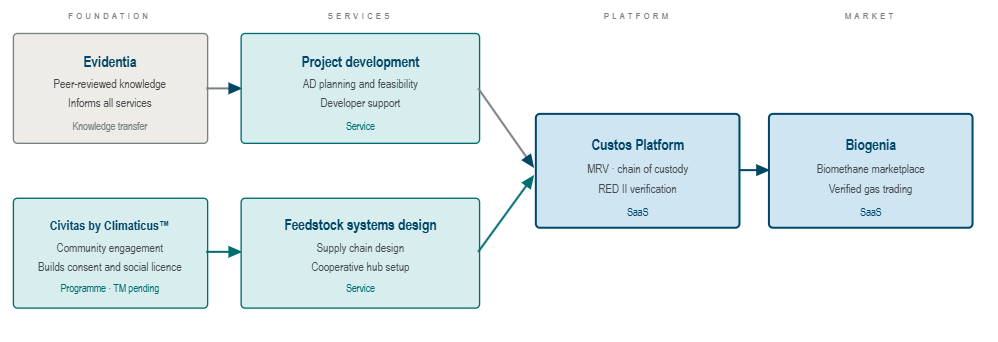
Diagram of the Climaticus ecosystem showing Evidentia and Civitas by Climaticus as foundations feeding Project Development and Feedstock Systems Design services, which connect to the Custos Platform and the Biogenia marketplace.
The Climaticus ecosystem: foundations, services, platform and market.

Climaticus is designed to address them across the whole system. From feedstock origination through project development, stakeholder engagement, measurement and verification, carbon markets and long-term operational partnerships, the business coordinates the components that consistently fail in isolation.

Two proprietary tools sit at the core of that system. Civitas by Climaticus is our structured stakeholder engagement methodology, built on the principles of procedural justice: that communities affected by energy infrastructure deserve a genuine voice in its development, and that projects founded on that principle are more resilient, more plannable and more consistent with the just transition that decarbonisation demands. The Custos Platform provides the data infrastructure: feedstock traceability, MRV, verification and reporting, connecting the physical supply chain to carbon and energy markets with the transparency that investors, regulators and partners require.

Together they enable Climaticus to organise feedstock, support infrastructure, enable verification, build participation and connect markets. The work precedes the value, and the platform captures both. Because both tools are built on principles rather than geography, the methodology transfers across Ireland, the UK, Europe, Australia and New Zealand while remaining responsive to local conditions.

Partners and stakeholders are built into the model at every stage. Farmers, communities, developers, large energy users and researchers are participants in the system, holding relationships and, where appropriate, stakes in the infrastructure. That breadth of partnership is both a commercial asset and a structural commitment to the shared value that a genuine just transition requires.