
Section 1: Principal development
The EPA publishes the nitrogen and phosphorus record that the derogation rests on.
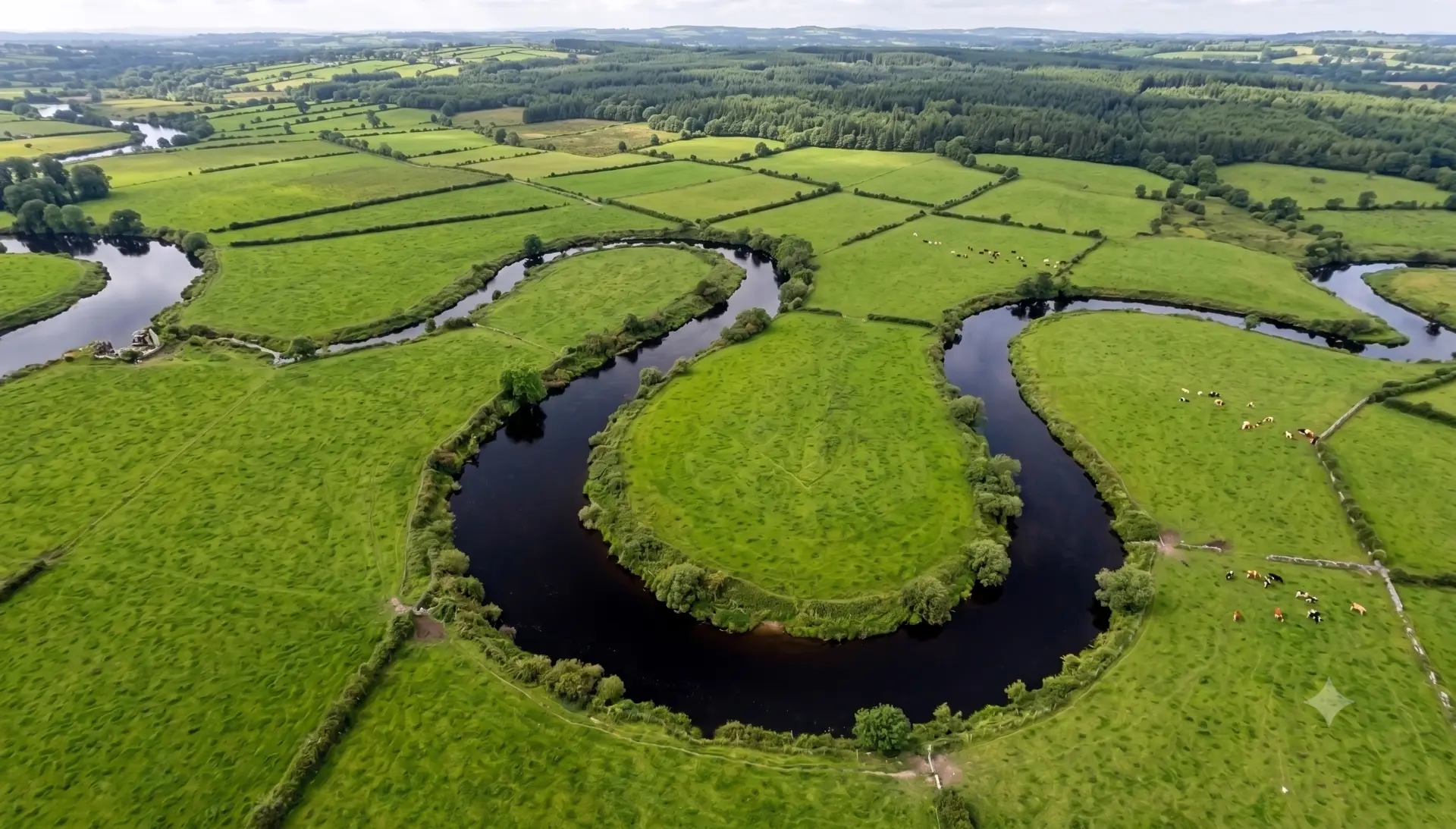
The Environmental Protection Agency published its Water quality monitoring report on nitrogen and phosphorus concentrations in Irish waters 2025 on 5 August, drawing on the national monitoring network to give the annual account of nutrient concentrations that the European Union treats as the evidence base for reviewing Ireland's nitrates derogation [EPA Catchments Unit, 5 August 2026]. It sits alongside the agency's broader June assessment, which found little overall improvement across 2025 and slightly more than half of rivers and lakes in good or better biological quality [EPA, 17 June 2026]. The measured trend worsened over the year, with the Early Insights indicator recording a 10% rise in average river nitrogen at twenty representative sites during 2025, concentrated in the higher-intensity, freely draining catchments where agriculture is the dominant pressure [EPA, 19 March 2026].
The stakes: The derogation permits participating farmers to stock above the 170 kg of livestock manure nitrogen per hectare baseline, up to 250 kg, and the water quality evidence is the test the Commission applies at review, so a worsening record raises the pressure on the nutrient loading Irish agriculture carries.
Who acts? The Department of Agriculture, Food and the Marine, the Department of Housing, Local Government and Heritage, Teagasc, the local authority waters programme and farmers in the higher-risk catchments carry the response, with the EPA supplying the monitoring evidence and the targeting maps.
What do they do? They reduce nitrogen and phosphorus losses at source, through fertiliser management, slurry handling and buffer measures, and they weigh treatment routes that convert slurry into a managed feedstock and a defined nutrient product.
Where the sector sits: Anaerobic digestion enters this as one treatment route among several, and its standing depends on evidence that digestate spreading lowers catchment nitrogen loss instead of relocating it, which the Irish monitoring record does not yet establish at catchment scale.
Section 2: Policy and regulation
2.1 The CBAM certificate trading consultation closes and the border levy enters its operating phase
The European Commission's consultation on the draft rules governing the sale and repurchase of Carbon Border Adjustment Mechanism certificates closed on 6 August, having opened on 9 July, which moves the mechanism from headline design into the operational detail importers will work to under the definitive regime that began on 1 January 2026 [EC Taxation and Customs Union]. The definitive regime applies core obligations to importers bringing more than fifty tonnes of covered goods into the Union each year, with the first annual declaration due by 30 September 2027 for the 2026 reporting year. The certificate price tracks the average auction price of EU allowances, and the most recently published quarterly figure set the second quarter of 2026 at €75.28 per tonne [EC Taxation and Customs Union].
2.2 Ireland's Renewable Heat Obligation remains unresolved after the standstill expiry
The Renewable Heat Obligation Bill completed priority drafting and went to the European Commission under Directive (EU) 2015/1535 on 23 December 2025, after which the Commission issued a formal Detailed Opinion on 29 March 2026 finding that the Bill's multiplier favouring indigenously produced biomethane was incompatible with internal market rules, characterising it as a measure of equivalent effect to a quantitative restriction under Article 34 of the Treaty on the Functioning of the European Union [William Fry, May 2026]. The standstill ran to 29 June 2026, and practitioner assessment holds that mid-2026 commencement is no longer realistic, with 2027 now the working assumption. The scheme as drafted obliges heating fuel suppliers to source a rising renewable share starting at 1.5% and moving to 3% in the second year, with year one spanning six months and year two a full calendar year [Pinsent Masons].
Section 3: Energy market
3.1 EU carbon holds above €80 as the reform beds in
EU allowances held above €80 per tonne at the start of August, keeping most of the ground gained after the Commission's 17 July reform package and easing from the six-month high near €86.6 reached on 22 July [GMK Center, August 2026] [Trading Economics]. A survey of nine analysts placed the 2026 average near €80 and the 2027 average near €89, which frames the current level as consistent with the projected path for the year.
3.2 Wind curtailment underlines the case for storable renewable energy
Analysis from Wind Energy Ireland, drawing on EirGrid data, reports that Ireland lost roughly 15% of the wind energy its farms generated during the first half of 2026, enough to power about 667,000 homes, as the system dispatched down 13.2% of available wind output and carried 86.8% onto the network [Wind Energy Ireland, July 2026] [RTÉ, 28 July 2026].
Section 4: Anaerobic digestion and circular bioeconomy
4.1 Central grid injection advances while Ireland builds from a small base
Gas Networks Ireland's €32m Central Grid Injection facility at Mitchelstown progressed on site through the summer, with foundations and apron works completed after mobilisation, on a facility designed to inject up to 700 GWh of renewable gas a year [Gas Networks Ireland] [Bioenergy Insight]. Ireland approaches its 2030 commitment from a small base, with two facilities injecting biomethane to the grid and producing approximately 75 GWh a year, under 1.5% of the 5.7 TWh target, and with the network operator estimating that meeting the target calls for up to 150 to 200 new anaerobic digestion plants [IFSC]. Across Europe, the European Biogas Association and Gas Infrastructure Europe reported on 1 July that installed biomethane capacity reached 8.2 bcm a year by the end of the second quarter of 2026, a 17% rise on 2025, with the plant count moving from 1,678 to 1,975 as 327 new facilities entered operation [European Biogas Association, 1 July 2026].
Section 5: Carbon, MRV and climate claims
5.1 Durable removal deals scale as the certification architecture settles
The carbon dioxide removal market recorded one of its largest engineered deals in the week to 2 August, when Frontier Infrastructure Holdings and Carbonfuture announced a bioenergy with carbon capture partnership making up to 750,000 durable removal credits available, in a market where biochar still supplied about 80% of removal deliveries [Carbon Removal Updates, week to 2 August 2026]. The deal sits on the certification base the Commission put in place on 3 February 2026, when it adopted the first methodologies under the QU.A.L.ITY criteria of quantification, additionality, long-term storage and sustainability, setting a 200-year permanence threshold for biochar carbon removal and for bioenergy with carbon capture and storage [European Commission, 3 February 2026] [Carbon Herald].
Section 6: Agriculture and Scope 3
6.1 The nutrient record meets the 2028 nitrates conditions
Ireland's nitrates derogation runs on the three-year extension the European Commission granted from 1 January 2026, carrying conditions that bite in 2028 when slurry storage requirements tighten for dairy farmers, derogation farm fertiliser limits reduce and buffer strip requirements widen on some holdings [Teagasc] [DAFM]. This week's monitoring record adds weight to those conditions, since the published nutrient data is the evidence the Commission weighs at review.
Section 7: Planning and social licence
7.1 A support document for planners takes shape while national guidance remains absent
Ireland still has no national planning guidelines specific to anaerobic digestion or biomethane facilities, which leaves applications assessed inconsistently from one local authority to another, and a biomethane implementation sub-group has been established to prepare a support document assisting local representatives and planning authorities in assessing applications, with that document expected during 2026 [Agriland] [Arthur Cox].
Section 8: Counter-signal
8.1 Planning refusals in 2025 and 2026, and the grounds recorded
CycleØ announced a €100m programme of four Irish biomethane plants, of which three applications have been refused planning permission at first instance. Limerick City and County Council refused the Cappanihane facility near Bruree after more than 400 submissions of which 333 were objections, citing odour prejudicial to public health, threats to the Lower River Shannon and River Fergus estuaries, an inadequate surface water management plan and local roads unable to carry the traffic safely [Bioenergy Insight] [Limerick Leader]. Galway County Council refused the Kellysgrove facility at Ballinasloe in January 2026, the third refusal in the programme following Kildare [Irish Farmers Journal, 28 January 2026]. Separately, Tipperary County Council rejected an application at Ballynilard south of Tipperary town in March 2026, where 163 of 168 submissions came from local residents, on grounds including withdrawn landowner consent, insufficient traffic and transport information, missing detail in the Environmental Impact Assessment Report on the daily discharge of 71,000 litres of wastewater to the River Arra, and the absence of a decommissioning plan [Nenagh Live, March 2026].
Section 9: Scholarly Spotlight
The finding
Murali and colleagues, publishing in Renewable and Sustainable Energy Reviews in January 2026, report that no industrially relevant decision-making tools currently exist for anaerobic digestion operators. The conclusion comes from a co-learning workshop of thirty specialists held at the University of Surrey under the Environmental Biotechnology Network and an Artificial Intelligence for Net Zero project, comprising three operators drawn from among the largest United Kingdom agricultural and waste anaerobic digestion companies, eight salespeople with on-site experience and seven engineers representing nine organisations. Paired with a review of one hundred and nine sources, the authors reach a second conclusion, which is that academic research on anaerobic digestion modelling has not aligned with operator need, concentrating on laboratory-scale scenarios and running modelling horizons of a few months or less because feedstock data availability constrains anything longer.
The context
Seven hundred and thirty anaerobic digestion plants operated in the United Kingdom during 2023 with 2,800 MW of installed capacity, and the paper describes them as operated conservatively on accumulated operator experience, because predicting system response to changing feedstocks defeats the available models. Read against this week's Irish figures, the point sharpens considerably. The 150 to 200 plants Ireland's 2030 commitment implies would be built into a technology base where the operating decisions that determine yield, digestate quality and gas consistency rest on judgement that the incoming cohort of Irish operators has not yet accumulated. Any buyer signing a multi-year offtake, and any lender pricing a plant, underwrites that condition.
The limitation
Thirty participants at a single workshop in one country is a qualitative sample, and the authors present it explicitly as an industrial perspective instead of a survey carrying statistical power. The finding establishes that practitioners recognise the gap, and it does not measure how widely the gap is felt across the European fleet or how it varies by plant scale and feedstock type. Three of the thirty participants were operators, with the remainder drawn from sales and engineering roles, so the operator voice the paper foregrounds rests on a narrow base. One author reports employment with a biogas company and several report Research and Innovation funding, both declared in the paper.
The implication
The paper reports that operator trust in machine learning models remains limited, which locates the barrier in verifiability instead of computational capability. Tools producing a prediction an operator cannot interrogate will continue to sit unused, however accurate they prove in validation, and the authors argue that co-creation between industry and academia is the condition for closing the gap. For a buyer, the practical consequence is that operational consistency at a given plant currently depends on individual operator experience, which is a question worth asking during due diligence. For a developer commissioning a first facility, it argues for budgeting operator capability alongside plant capital.
Section 10: Commercial opportunities
Deadline: 22 September 2026
Covering bio-based value chains, the circular bioeconomy and agri-food systems. [CBE JU]
Expression of interest expected September or October 2026, grant allocations targeted before year end
Secured through the National Development Plan and the Infrastructure, Climate and Nature Fund, following almost €19m already issued to seven projects. The Sectoral Capital Plan 2026 to 2030 allocates €100m to €200m for biomethane. [Irish Farmers Journal, 1 July 2026]
Status at 7 August 2026: foundations and apron works complete, commissioning date not published
Designed to inject up to 700 GWh a year. Producers within the catchment should engage on connection and offtake terms ahead of commissioning. [Gas Networks Ireland]
Methodologies adopted 3 February 2026, Puro.earth programme open
Operators can assess digestate pyrolysis and carbon dioxide capture against the QU.A.L.ITY criteria and the 200-year permanence threshold. [Carbon Herald]
20 to 21 October 2026, pre-registration open
Held at the Convention Centre Dublin during Ireland's Presidency of the Council of the European Union. [GBS 2026]
Section 11: The Standing Watch
| Issue | Status at 7 August 2026 | Movement |
|---|---|---|
| Renewable Heat Obligation commencement | Standstill expired 29 June 2026, redesign required after the Commission's Detailed Opinion, 2027 the practitioner working assumption against a departmental target of 2026 | Unchanged |
| Nitrates derogation review | 2025 nutrient monitoring published 5 August, measured river nitrogen up 10% at Early Insights sites | Moved |
| CBAM implementing detail | Certificate sale and repurchase consultation closed 6 August, rules not yet published | Moved |
| National AD planning guidance | Support document in preparation by the biomethane implementation sub-group, expected during 2026, no statutory guidance | Unchanged |
| Second-round AD capital grants | Expression of interest expected September or October 2026 | Unchanged |
| CRCF methodology adoption | First permanent methodologies adopted 3 February 2026, Puro.earth certification programme open | Unchanged |
| Ireland and the London Protocol export amendment | Ireland not among ratifying states, Commission maintains the EU framework constitutes the Article 6(2) arrangement, contested | Unchanged |
Section 12: Where this lands
Four Irish planning decisions across 2025 and 2026 cited inadequate environmental assessment, unresolved wastewater detail, traffic capacity and absent decommissioning plans, and objector groups in two cases stated that their opposition addressed the site and not the technology. Civitas by Climaticus structures engagement around the evidential and consultation record that a decision on those grounds turns on, which is a distinct task from communicating the benefits of anaerobic digestion.
The Mitchelstown facility removes the requirement for each plant to sit beside a suitable grid connection, which widens the feedstock catchment a single injection point serves and brings producers into offtake range who were previously outside it. The Biogenia Marketplace carries the connection and offtake intelligence for producers assessing that catchment.
The 200-year permanence threshold treats pathways with materially different storage durations as equivalent, and buyers are likely to price that distinction before regulators do. Operators building removal projects from digestate pyrolysis or captured biogenic carbon dioxide need chain of custody records granular enough to evidence pathway and permanence separately, which is the function Custos by Climaticus performs.
Sources cited in this issue
- EPA Catchments Unit, Water quality monitoring report on nitrogen and phosphorus concentrations in Irish waters 2025, 5 August 2026: catchments.ie
- Environmental Protection Agency, River nitrogen levels increased in 2025, 19 March 2026: epa.ie
- Environmental Protection Agency, Faster action is needed as water quality shows little overall improvement in 2025, 17 June 2026: epa.ie
- European Commission Taxation and Customs Union, Carbon Border Adjustment Mechanism: taxation-customs.ec.europa.eu
- European Commission Taxation and Customs Union, CBAM certificate prices: taxation-customs.ec.europa.eu
- William Fry, Ireland's Renewable Heat Obligation, May 2026: williamfry.com
- Pinsent Masons, Proposed Renewable Heat Obligation as a market signal for Irish biomethane: pinsentmasons.com
- GMK Center, European carbon prices exceeded €80/t at the start of August, August 2026: gmk.center
- Trading Economics, EU carbon permits price: tradingeconomics.com
- Wind Energy Ireland, Ireland lost 15 per cent of wind power in the first half of 2026: windenergyireland.com
- RTÉ, Wind energy to power 667,000 homes lost in six months, 28 July 2026: rte.ie
- Gas Networks Ireland, Mitchelstown Central Grid Injection Facility: gasnetworks.ie
- Bioenergy Insight, Construction begins on Gas Networks Ireland's €32m biomethane facility: bioenergy-news.com
- IFSC, Ireland committed to 5.7 TWh of indigenous biomethane by 2030: ifsc.ie
- European Biogas Association, Europe adds 1 bcm of biomethane production, 1 July 2026: europeanbiogas.eu
- Carbon Removal Updates, Carbon removal weekly summary, week to 2 August 2026: carbonremovalupdates.substack.com
- European Commission, EU sets world's first standard for permanent carbon removals, 3 February 2026: climate.ec.europa.eu
- Carbon Herald, Puro.earth launches new CRCF programme: carbonherald.com
- Carbon Market Watch, Commission waters down flagship climate policy, 17 July 2026: carbonmarketwatch.org
- Teagasc, Nitrates Derogation: teagasc.ie
- Department of Agriculture, Food and the Marine, Minister Heydon on the continued availability of the Nitrates Derogation: gov.ie
- Agriland, AD planning guidelines expected in 2026: agriland.ie
- Arthur Cox, Biomethane: guide to project development in Ireland: arthurcox.com
- Bioenergy Insight, County Limerick blocks CycleØ's biomethane plant: bioenergy-news.com
- Limerick Leader, Planners refuse proposed €100m biomethane plant in County Limerick: limerickleader.ie
- Irish Farmers Journal, Third CycleØ AD plant proposal refused, 28 January 2026: farmersjournal.ie
- Nenagh Live, County Council has rejected a planning application for an anaerobic digestor facility, March 2026: nenaghlive.ie
- Echo Live, Hoey family-controlled agri-business secures planning for Dublin anaerobic digestion facility, 25 May 2026: echolive.ie
- Irish Farmers Journal, Renewed optimism as Minister reaffirms AD plans, 1 July 2026: farmersjournal.ie
- Murali, R. et al. (2026) Anaerobic digestion site-wide optimisation and decision-making: An industrial perspective and review. Renewable and Sustainable Energy Reviews, 226(D), 116402: doi.org
- CBE JU, €170.7m 2026 call for proposals: cbe.europa.eu
- Global Bioeconomy Summit 2026: gbs2026.org
- The Climaticus Brief, issue of 31 July 2026: climaticus.ie/briefings/31July2026
- Climaticus, Stakeholder-Centred Governance: climaticus.ie/stakeholder-centred-governance

Keeping up with Climaticus
Sign up to receive a monthly newsletter with the most important news and research from the briefings and beyond.
Your email will be used only to send the Climaticus monthly newsletter. You can unsubscribe at any time.