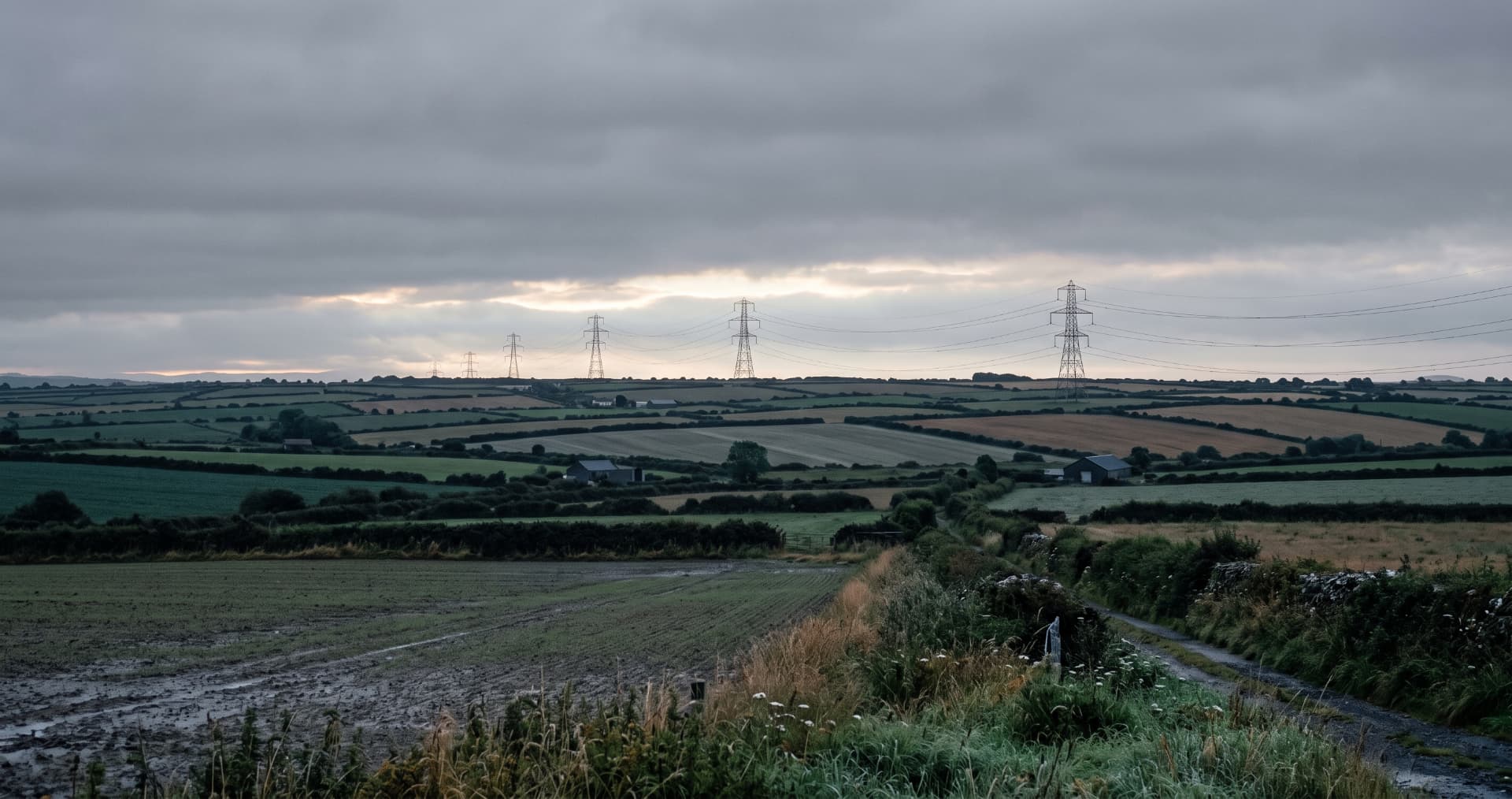

Section 1: Principal development
Ireland debates a fossil fuel exit date while its own gas replacement goes unnamed
The Irish Times published an analysis on 17 September 2026 arguing that Ireland has never set a target date for the complete phase-out of fossil fuels, despite a substantial decline in their use since a 2008 peak: coal and peat now sit below 13% of 2008 levels, and oil and gas together have fallen by a fifth, even as the population has grown by close to a quarter and the economy has expanded 1. The article draws on two primary sources. The Sustainable Energy Authority of Ireland's July 2026 energy security report put overall renewable energy at a record 15.9% of national demand in 2025, fossil fuels at 79.2%, and import dependency at 78.2%, with more than four-fifths of natural gas itself imported 2. University College Cork's Energy Policy and Modelling Group, in a 2050 pathways report published in September 2024, models an economy-wide shift built on electrification, projecting electricity's share of final energy to rise from 22% in 2020 to 41% by 2030 and 69% by 2040, with biogas appearing only as a minor input of roughly 3.2 TWh used within industry by 2030 under its mid-range scenario 3. Both documents are older than this week's news and are cited here as the evidence base the newspaper drew on, not as new developments in themselves.
The stakes: Fossil fuels supplied 79.2% of Ireland's total energy requirement in 2025, oil close to half of that and imported fossil natural gas around three-tenths, against a renewable share that reached a record 15.9%, meaning four-fifths of the state's energy still runs on imported or extracted fuel with no published date by which that changes. The natural gas share matters specifically because it is the fuel biomethane displaces molecule for molecule on the grid, so a fossil gas share left unnamed in this debate is a biomethane opportunity left unnamed with it.
Who acts? The Department of Climate, Energy and the Environment, which owns the national energy policy framework and the Renewable Heat Obligation built to displace fossil heat with biomethane; the Sustainable Energy Authority of Ireland, which compiles the underlying statistics; and University College Cork's Energy Policy and Modelling Group, whose pathway work underpins much of the modelling in circulation.
What do they do? The Department can publish the target date the newspaper says is missing, and it can use that date to anchor the Renewable Heat Obligation's delayed commencement to a fixed point instead of the shifting practitioner assumption now in use.
Where the sector sits: Anaerobic digestion and biomethane are the only indigenous substitute for a meaningful share of the imported fossil natural gas that SEAI's own figures show still running through Ireland's grid, yet neither this debate nor the modelling behind it treats that substitution as a distinct pathway worth naming, folding it instead into a minor industrial input inside a much larger electrification story.
Section 2: Policy and regulation
The renewable gas certification registry marks its eighth year without a permanent home
Gas Networks Ireland's own account of its Green Gas Certification Registry traces the initiative to an innovation project first referenced in 2019, built on a 2018 sector blueprint, with first injections and a manual pilot registry established from 2020, formal appointment of Gas Networks Ireland as Issuing Body under Statutory Instrument 350 in 2022, and the Commission for Regulation of Utilities beginning supervisory engagement from 2023 5. The pilot has operated throughout on a spreadsheet-based system with manual processes. The CRU's decision paper of March 2026 committed Gas Networks Ireland to publishing finalised registration requirements for a permanent, automated registry no later than September 2026, with certificate issuance beginning no later than January 2027 6. Gas Networks Ireland's own most recently published project schedule sets tender issuance for the replacement software in May or June 2026, an implementation phase across the fourth quarter of 2026, and a go-live date only in the first quarter of 2027 5. With a week of September left at the time of writing, the finalised requirements the CRU committed to have not been published, and this issue could not confirm whether the tender scheduled for May or June was in fact issued on time.
Section 3: Energy market
EU carbon allowances edge to €86 a tonne on the same secondary data this issue has tracked for six weeks
EU carbon allowances reached €86.01 a tonne on 23 September 2026, according to Trading Economics' tracking of the front-month ICE EUA futures contract, before easing 0.83% the following session 4. This is the fifth reading in this figure's series since April, when Trading Economics recorded €74.80: €83.80 on 4 September, €84.93 on 7 September, €85.34 on 11 September and now €86.01 on 23 September 4. Every one of those five readings comes from the same aggregator's tracking of front-month futures activity, and none has yet been checked against ICE's own published settlement data.
Section 4: Carbon, MRV and climate claims
Brussels grants its own methane transparency database a delay Dublin was not granted for renewable gas certification
Trade coverage reported in mid-July 2026 that the European Commission had confirmed its EU Methane Transparency Database, intended to publish measured emissions data, drawn from direct monitoring rather than self-reported estimates, for oil, gas and coal placed on the EU market under Regulation (EU) 2024/1787, would launch in September 2026 rather than the February 2026 date the regulation originally set 7. The reported ten-month slip followed pressure from eleven member states seeking a longer transition period. This issue could not locate the Commission's own confirmation of the revised date at the time of writing and reports the figure here as trade coverage of an announcement whose underlying release was not publicly available. The database's scope is fossil fuels only: oil, gas and coal placed on the EU market carry the obligation, and biomethane and other renewable gas carry none of it.
Section 5: Agriculture and Scope 3
The autumn closed period leaves a widening gap between digestate output and legal spreading windows
Teagasc's guidance on the 2026 closed period confirms that the prohibition on spreading chemical nitrogen and phosphorus fertiliser begins on 15 September in the most restrictive zone, that farmyard manure spreading must stop by 1 November, and that the autumn closed period for slurry and other organic manures begins on 1 October, with zone-specific reopening dates running from 12 January through to 31 January depending on location 8. Digestate from anaerobic digestion falls under the same organic manure rules as slurry in current guidance, and the published dates carry no separate provision for the volumes a plant continues to produce, and must store, once its own feedstock intake does not pause for the calendar.
Section 6: Scholarly Spotlight
The finding
Rahic, Kelly, Karsten, de Lima Casseres dos Santos and Costello, publishing in Environmental Science & Technology in December 2025, ran a life cycle assessment of a simulated large Pennsylvania dairy farm adopting the "Grass2Gas" approach, combining continuous vegetative cover, manure management and anaerobic digestion 10. The modelled system reduced the carbon footprint of milk production by more than 20% relative to conventional management. The same modelling identified a direct trade-off: growing additional biomass for the digester to maintain year-round ground cover increased the farm's need for off-farm feed imports in most scenarios modelled, which offset a meaningful share of the water quality benefit the continuous cover was intended to deliver on a full life cycle basis. A further scenario, matching herd size to the feed a farm could grow on its own land, produced milk losses the authors describe as comparable in scale to typical waste already occurring elsewhere in the dairy supply chain.
The context
This week's agriculture section works through the storage arithmetic a closed spreading period imposes on a continuously operating digester; this paper works through a parallel arithmetic on the input side, showing that growing the biomass to keep a Grass2Gas-style system fed can itself generate an emissions and land-use cost large enough to erode the carbon benefit the system is built to deliver. Anyone treating anaerobic digestion's climate case as self-evidently positive once a digester is running is skipping the feedstock question this paper puts back on the table.
The limitation
The study is a simulation of one farm type in one American state, built on Pennsylvania's climate, land availability, feed markets and manure-management regulation, none of which map directly onto an Irish grass-based dairy system with different stocking rates, different rainfall patterns and a different regulatory closed period. The 20% figure describes an outcome reached in simulation, and no operating farm has yet measured it directly; the milk-loss comparison to supply chain waste is also one normative framing among several the authors could have chosen to describe the same underlying trade-off. A reader should treat the direction of the finding, that feedstock sourcing can erode digestion's climate benefit, as more transferable than the specific percentage attached to it.
The implication
A developer or an advisor promoting anaerobic digestion's climate credentials to a farmer or a buyer should be able to answer where the additional feedstock biomass comes from and what its own footprint is, not only what the digester itself achieves once fed. A system that improves on-farm carbon accounting by importing more feed from elsewhere is relocating emissions, not removing them, and the paper's own herd-size scenario suggests that matching feedstock ambition to what a farm can actually grow keeps that relocation from happening in the first place.
Section 7: Commercial opportunities
8 October 2026, Killashee Hotel, Naas, Co. Kildare
Running as two dedicated events under one umbrella for the first time in 2026, covering the bioenergy, biogas and biofuel sectors. 11
20 to 21 October 2026, pre-registration open
Held at the Convention Centre Dublin during Ireland's Presidency of the Council of the European Union. 12
Finalised requirements originally due no later than September 2026, now unmet; Gas Networks Ireland's own schedule targets go-live in the first quarter of 2027
Producers, traders and suppliers wishing to hold or trade certificates should confirm registration arrangements directly with Gas Networks Ireland and the CRU once published. 5
Market intelligence only, not a confirmed opening; trade press has expected an expression of interest process since Q3 2026, with no date yet published
Reported at up to €200m across the National Development Plan; applicants should verify directly with the Department. 13
Section 8: The Standing Watch
| Issue | Status at 25 September 2026 | Movement |
|---|---|---|
| Renewable gas Guarantees of Origin registry | Finalised requirements remain unpublished as September closes; Gas Networks Ireland's own schedule now targets a Q1 2027 go-live, with the intervening tender stage unconfirmed | Moved |
| Renewable Heat Obligation commencement | The Department's original 2026 legislative-basis ambition and the practitioner's 2027 working assumption remain unreconciled; see this issue's flag | Unchanged |
| Biomethane grid connection pipeline | Unchanged since 18 September; three of seven contracted producers connected, combined developer-reported nameplate capacity of roughly 270 GWh against approximately 741 GWh under connection agreements | Unchanged |
| European biomethane sector consolidation | No further consolidation activity reported since Kanadevia Inova's 15 September acquisition of BioValue | Unchanged |
| Green claims and climate neutrality claims | Ireland's S.I. No. 124 of 2026 comes into operation 27 September 2026, two days after this issue publishes; CCPC enforcement approach not yet tested | Moved |
| CBAM implementing detail and the Russia WTO challenge | Russia's expected second panel request falls at the Dispute Settlement Body meeting of 25 September 2026, the day this issue publishes; automatic panel formation would follow if the request proceeds as expected | Moved |
| National AD planning guidance | Killough (case 500924) remains live with no decision recorded as of 24 September 9, against An Coimisiún Pleanála's own marker that it could not decide before 30 September; Corracunna remains undecided | Unchanged |
| Second-round AD capital grants | Reported at up to €200m across the National Development Plan; no confirmed expression of interest date | Unchanged |
| Nitrates derogation review | 2026 derogation applications processed via Agfood portal; no further movement this week | Unchanged |
| CRCF methodology adoption | First permanent methodologies adopted 3 February 2026; Puro.earth certification programme open | Unchanged |
| Ireland and the London Protocol export amendment | Ireland not among ratifying states; Commission maintains the existing EU framework satisfies Article 6(2), contested | Unchanged |
Section 9: Acting on it
This issue's account of the Guarantees of Origin registry's repeatedly reset schedule means a producer or trader needing to demonstrate provenance to a counterparty before the permanent system goes live cannot rely on that system's own timeline. Custos by Climaticus is built to hold exactly that kind of audit-ready feedstock and output record independent of any single national registry's go-live date, though whether a given producer needs it depends on what its specific counterparties are asking it to prove.
This issue's agriculture section works the arithmetic showing that a seventeen-week closed period compounds directly into storage volume; a plant supplying or receiving from land in the most restrictive zone needs capacity calculated against that zone's calendar, not a more favourable one elsewhere in the state.
This issue's principal development shows that an unnamed exit date leaves indigenous gas with no forcing function distinct from the general climate commitments every fossil fuel already sits under; naming the sector inside a dated target is what would give project finance a fixed point to underwrite against.
Sources cited in this issue
- The Irish Times, When will Ireland finally achieve full fossil fuel phase-out?, 17 September 2026: irishtimes.com ↩ ↩ ↩
- Sustainable Energy Authority of Ireland, Significant reliance on imported fossil fuels leaves Ireland exposed to global energy shocks despite renewable energy progress (First Look: Ireland's Energy Supply and Security of Supply 2025), 9 July 2026: seai.ie ↩ ↩
- University College Cork, Energy Policy and Modelling Group, Pathways for Ireland's Energy System to 2050, September 2024: ucc.ie ↩ ↩ ↩
- Trading Economics, EU Carbon Permits price data and commentary, 23 September 2026: tradingeconomics.com ↩ ↩
- Gas Networks Ireland, Innovation Project Reference Number 2019-020, Green Gas Certification Registry: gasnetworks.ie ↩ ↩ ↩
- Commission for Regulation of Utilities, Decision Paper CRU202615, Guarantees of Origin for Renewable Gas: Development of the Supervisory Framework, 24 March 2026: cru.ie ↩
- Petro Online, EU Methane Transparency Database now due in September 2026, European Commission confirms, 16 July 2026: petro-online.com ↩
- Teagasc, Fertiliser spreading: key dates approaching: teagasc.ie ↩
- An Coimisiún Pleanála, Case 500924 (Killough biomethane facility appeal): pleanala.ie ↩
- Rahic, E., Kelly, D., Karsten, H., de Lima Casseres dos Santos, L. and Costello, C. (2025) Integrating Continuous Cover, Manure Management, and Anaerobic Digestion Strategies on a Pennsylvania Dairy Farm: A Life Cycle Assessment. Environmental Science & Technology, 59(49), 26514–26525: doi.org ↩
- IrBEA, National Bioenergy Conference, 8 October 2026: nationalbioenergyconference.ie ↩
- Global Bioeconomy Summit 2026: gbs2026.org ↩
- Agriland.ie, Process for next round of biomethane capital grants to begin soon: agriland.ie ↩

Keeping up with Climaticus
Sign up to receive a monthly newsletter with the most important news and research from the briefings and beyond.
Your email will be used only to send the Climaticus monthly newsletter. You can unsubscribe at any time.