
Section 1: Principal development
Ireland pays its first biomethane grants, and hands €21m back to Brussels.
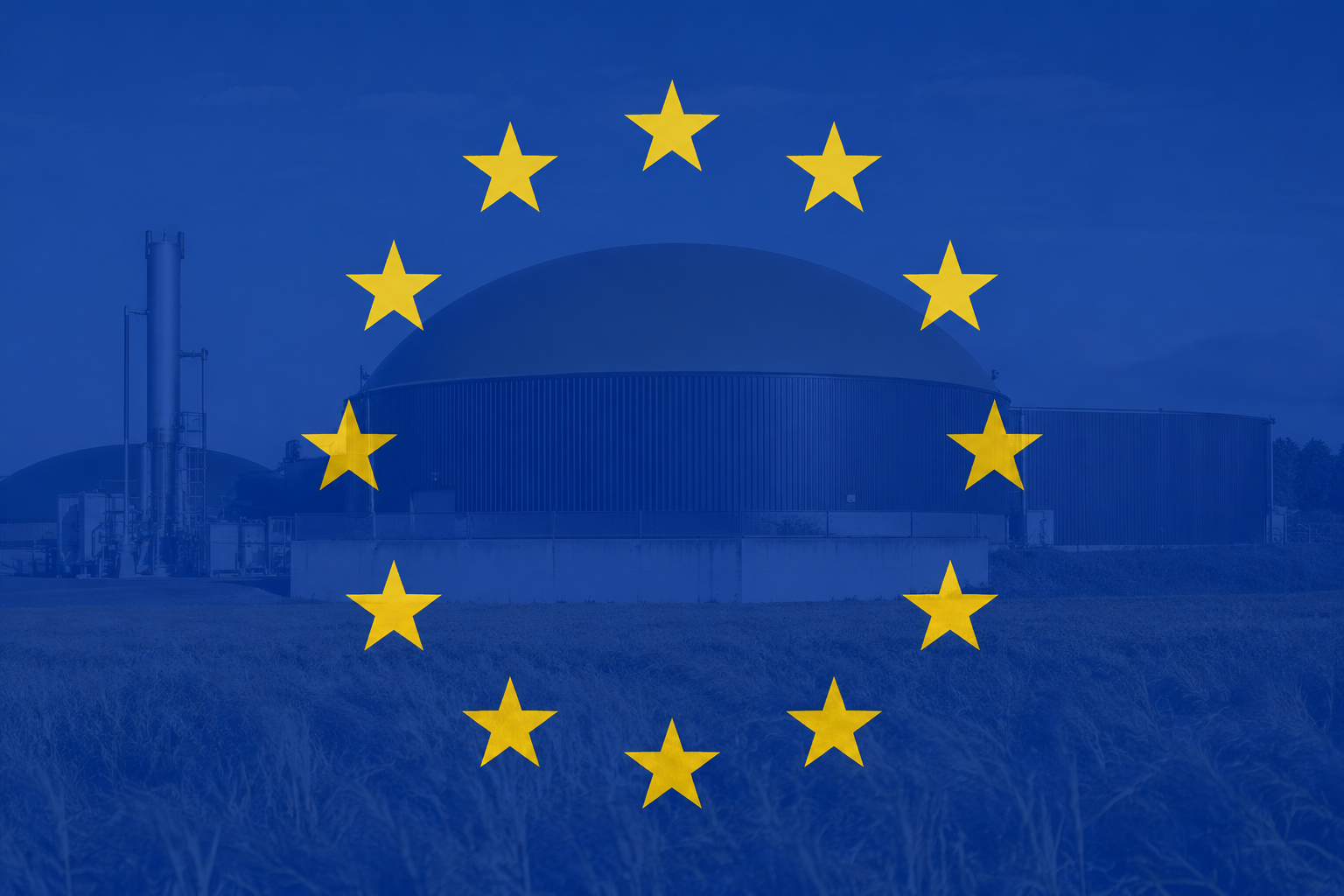
Payments under the 2024 Biomethane Capital Grant Scheme began issuing on 15 July 2026, with almost €19m going to seven anaerobic digestion projects to build or upgrade plants for grid injection [DAFM, official, 15 July 2026]. The seven together carry roughly 10% of the 2030 target of up to 5.7 TWh, equivalent to the heat demand of some 56,000 homes. The scheme was worth €40m, drawn through the EU Recovery and Resilience Facility, so the €21m left unallocated after only seven of twenty-three applicants qualified returns to the EU and cannot be redeployed. Applicants who fell away pointed to the absence of an offtake market, planning difficulty and delivery terms they described as unrealistic, chief among them a requirement to be producing biomethane by December 2025 [Irish Farmers Journal, 15 July 2026].
The stakes: The underspend is the clearest signal yet that capital alone will not build the sector. Route to market, planning certainty and realistic timelines have to arrive together, or public money keeps going back to Brussels while the 2030 target slips further out of reach.
Who acts? The Department of Climate, Energy and the Environment, DAFM, SEAI, developers preparing for the €200m second round, and the farmers and co-operatives who supply feedstock.
What do they do? Design the next scheme around bankable delivery rather than a fixed calendar date, and pair capital with the offtake and planning conditions that let projects proceed.
How does Climaticus support them? Civitas by Climaticus reads scheme design against real project readiness, and the Biogenia Marketplace addresses the offtake gap that unsuccessful applicants named as their first obstacle.
Section 2: Policy and regulation
2.1 Commission set to publish ETS revision and Electrification Action Plan on 17 July
The European Commission prepared to unveil its Electrification Action Plan and a full revision of the Emissions Trading System on 17 July 2026. The electrification plan sets a course towards a binding 2040 electrification target, VAT relief for heat pumps, batteries and electric vehicles, and a storage ambition of 200 GW by 2030 [Euronews, 9 July 2026]. The ETS revision aligns the cap with the 90% net 2040 target through a recalibrated linear reduction factor, reworks the Market Stability Reserve and free allocation, and for the first time opens the system to permanent carbon removals certified under the EU Carbon Removal Certification Framework [OPIS] [European Commission].
2.2 Ireland's Renewable Heat Obligation stays in final legal review
The Renewable Heat Obligation remains among the highest legislative priorities of the Department of Climate, Energy and the Environment, with draft legislation in final legal review. The scheme will proceed without the domestic biomethane multiplier that drew a Commission Detailed Opinion in March, obliging suppliers of heating fuel to source 1.5% renewable energy in a first six-month year, rising to 3% in 2027 [Pinsent Masons] [Dept of Climate, Energy and the Environment].
2.3 CBAM Q2 2026 certificate price set at €75.28
The Carbon Border Adjustment Mechanism certificate price for the second quarter of 2026 stands at €75.28 per tonne, published on 6 July, marginally below the €75.36 set for the first quarter and tracking the average EU ETS price across the quarter [EC Taxation and Customs Union].
Section 3: Energy market
3.1 EU carbon holds above €80 into the reform
EU carbon allowances traded near €81 in mid-July, easing to €80.89 on 15 July, close to their strongest levels since February as the market positioned ahead of the ETS revision [Trading Economics].
Section 4: Anaerobic digestion and circular bioeconomy
4.1 European biomethane capacity passes 8 bcm for the first time
The European Biogas Association's European Biomethane Map 2026 puts installed biomethane capacity at 8.2 bcm a year by the end of the second quarter, up 17% year on year, with the plant fleet growing from 1,678 to 1,974 as 327 new facilities came on stream [European Biogas Association]. France, Germany, Italy, Denmark and the United Kingdom lead production, and 101 bio-LNG plants now operate across 16 countries.
4.2 The seven Irish grant projects, mapped
The projects funded on 15 July span Dublin, Donegal, Meath, Kildare, Tipperary and Laois, led by Evergreen Agricultural Enterprises in Kildare at the €5m per-project ceiling and Bia Energy in Dublin at €3.9m. SEAI administered the technical evaluation alongside DAFM [DAFM, official].
4.3 Straw emerges as a European AD feedstock
Trade coverage this week tracked the rising use of straw as an anaerobic digestion feedstock across Europe, widening the feedstock base beyond slurry and energy crops and easing some of the land-use pressure that shadows the sector [Irish Farmers Journal, 15 July 2026].
The Biogenia Marketplace provides structured commercial intelligence on biomethane offtake, feedstock and grid-connection opportunities across Ireland and the EU.
Section 5: Carbon, MRV and climate claims
5.1 The ETS opens to certified carbon removals
The 17 July ETS revision is expected to bring permanent carbon removals certified under the EU Carbon Removal Certification Framework into the trading system for the first time, with three integration models under consideration: central public purchase with equivalent allowances issued, operator-led procurement and surrender, and a one-in, one-out mechanism that reduces auctions for each removal surrendered. The shift moves the system towards net rather than gross emissions accounting [OPIS] [Carbon Gap, CRCF tracker].
Section 6: Agriculture and Scope 3
6.1 Nitrates derogation runs on under sharper water-quality scrutiny
Ireland's nitrates derogation, extended to the end of 2028 from 1 January 2026, continues under tightening conditions, with holdings in poorer water-quality catchments capped at 220 kg organic nitrogen per hectare. The European Commission's first full evaluation of the Nitrates Directive found the law effective overall while flagging that Ireland's exception may be reducing its protection, and an EU court adviser cast doubt on the derogation's compatibility with the Water Framework Directive in March [DAFM, official] [Irish Times, 26 March 2026].
The stakes: Stocking-rate limits shape the slurry and manure feedstock base for anaerobic digestion. Nutrient pressure and AD feedstock supply are two readings of the same catchment.
Who acts? Dairy and livestock farmers, co-operatives, and biomethane developers sourcing agricultural feedstock.
What do they do? Align nutrient-management and feedstock plans with catchment conditions, and treat AD as a nutrient-management tool alongside its energy value.
How does Climaticus support them? The co-operative hub model links nutrient management to feedstock supply, with Custos providing the monitoring and reporting that catchment conditionality now requires.
6.2 Biomethane framed as a farm income and abatement route
Ministers again tied the biomethane grants to farm-level benefit, presenting anaerobic digestion as a route to diversified income and emissions abatement as the payments issued [DAFM, official].
Section 7: Planning and social licence
7.1 Planning delay named as a reason projects fell away
Among the sixteen applicants who failed to secure grant funding, planning difficulty ranked with thin offtake markets and unworkable timelines as a reason projects could not proceed to construction. The Minister for Agriculture, Food and the Marine has separately committed to planning guidelines for anaerobic digestion plants, a step the sector has pressed for as consenting uncertainty stalls development [Irish Farmers Journal, 15 July 2026] [Irish Farmers Journal].
Section 8: Commercial opportunities
Secured through the National Development Plan and Infrastructure, Nature and Climate Fund process, a second round of anaerobic digestion capital grants is in early design and expected to open from late 2026, running to 2030. Developers should prepare bankable project documentation now. [DAFM, official]
With draft legislation in final legal review, obligated suppliers and biomethane producers should ready themselves for a certificate-trading market once the scheme commences. [Dept of Climate, Energy and the Environment]
Deadline 22 September 2026, covering bio-based value chains, circular bioeconomy and agri-food systems. [CBE JU]
The ETS revision opens a route for CRCF-certified removals into the carbon market. Producers of biogenic CO2 should map their potential against the emerging certification and offtake structures. [Carbon Gap]
Pre-registration is open for the summit at the Convention Centre Dublin during Ireland's EU Presidency. [GBS 2026]
Section 9: Implications for Climaticus and its partners
Returning €21m to Brussels because projects lacked a market, planning certainty or a workable timeline confirms that capital grants are the easy part. The differentiator for the second €200m round is a scheme built around bankable delivery. The Biogenia Marketplace tackles the offtake gap that unsuccessful applicants named first, and Civitas by Climaticus reads scheme design against real project readiness.
Bringing certified removals into the carbon market raises the premium on MRV quality for every producer of biogenic CO2. Partners monetising anaerobic digestion carbon should treat certification as core infrastructure. The Custos Platform provides the verification that a removals-integrated ETS makes increasingly valuable.
Consenting delay has moved from background risk to a named cause of scheme underspend. Dedicated AD planning guidance would remove a barrier that grant deadlines assume away. Partners should factor consenting timelines into every project plan, and Civitas tracks the guidance as it develops.
The tightening nitrates derogation ties farm-level nutrient limits to water-quality outcomes at sub-catchment scale. For partners, anaerobic digestion is both a nutrient-management tool and an energy play. The co-operative hub model and Custos monitoring address the two together.
With ETS allowances above €80 and CBAM above €75, the commercial value of an independently verified emissions profile continues to rise. Partners monetising biomethane or biogenic CO2 should treat MRV as a differentiator, supported by the Custos Platform.
Sources cited in this issue
- Irish Farmers Journal, €21m biomethane funding unspent, 15 July 2026: farmersjournal.ie
- DAFM, biomethane capital grant payments to issue, 15 July 2026: gov.ie
- Euronews, electrification draft, 9 July 2026: euronews.com
- OPIS, EU ETS revision 2026 preview: opis.com
- European Commission, about the EU ETS: climate.ec.europa.eu
- Pinsent Masons, RHO as a market signal for Irish biomethane: pinsentmasons.com
- Department of Climate, Energy and the Environment, Renewable Heat Obligation: gov.ie
- EC Taxation and Customs Union, CBAM certificate prices: taxation-customs.ec.europa.eu
- Trading Economics, EU ETS price: tradingeconomics.com
- European Biogas Association, European Biomethane Map 2026: europeanbiogas.eu
- Irish Farmers Journal, straw as European AD feedstock, 15 July 2026: farmersjournal.ie
- Carbon Gap, EU Carbon Removal Certification Framework tracker: tracker.carbongap.org
- DAFM, nitrates derogation secured: gov.ie
- Irish Times, EU court adviser on nitrates derogation, 26 March 2026: irishtimes.com
- Irish Farmers Journal, Minister commits to AD planning guidelines: farmersjournal.ie
- CBE JU, €170.7m 2026 call: cbe.europa.eu
- Global Bioeconomy Summit 2026: gbs2026.org
- Climaticus governance: climaticus.ie/stakeholder-centred-governance

Keeping up with Climaticus
Sign up to receive a monthly newsletter with the most important news and research from the briefings and beyond.
Your email will be used only to send the Climaticus monthly newsletter. You can unsubscribe at any time.