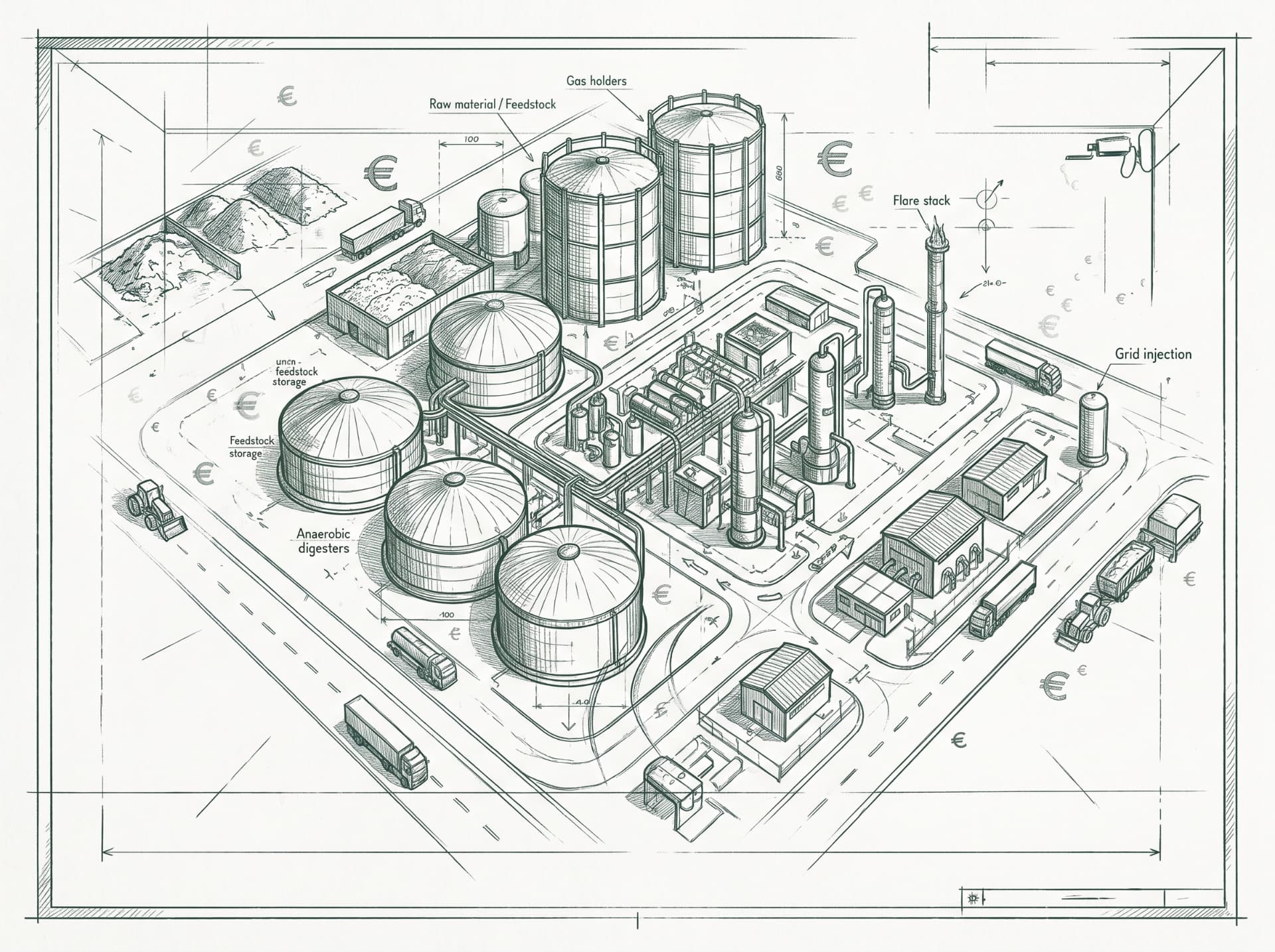

Ireland's €200 million biomethane grant opens with an expression of interest that closes on 30 October
The Department of Climate, Energy and the Environment opened a voluntary expression of interest for its €200 million biomethane grant on 8 October 2026, closing at 5pm on 30 October, to gauge project scale and readiness before publishing grant rates, a cap or application dates.
Minister Darragh O'Brien called the opening an important milestone and urged prospective developers to engage with it [1]. The money comes from the updated National Development Plan as a second round of capital grants, and the Department expects the scheme to run through several funding rounds between 2026 and 2030 [1][2]. A secondary summary published on 12 October repeats those terms and the closing time [3].
Taking part is optional, and a developer who stays out will not be treated as ineligible, but the Department will use the responses to size the pipeline and to design the first funding call, so those who respond help set the terms [1][2]. Detailed eligibility will follow in the terms and conditions of the formal round, and any award will depend on those terms, on the money available and on compliance with State aid and public expenditure rules [2]. Neither Department page gives a grant rate, a project cap or a co-funding requirement, and neither mentions the Renewable Heat Obligation [1][2].
Key factsFunding: up to €200 million, stated by the Government.
Target: up to 5.7 TWh of biomethane a year.
Closes: 5pm, Friday 30 October 2026.
Open for 22 days from 8 October, by our count.
Department of Climate, Energy and the Environment [1][2]
The stakes: €200 million of announced funding sits against a target of 5.7 TWh a year, and the formal round opens on a date that the Department has not given [1][2].
Who acts? The Department designs the round under Minister O'Brien, State aid rules govern its terms, and developers and their lenders decide whether to respond [2].
What do they do? The Department can publish the rate, the cap and the timetable, a developer can submit its details by 30 October, and a lender can ask which of those details the project can already evidence [2].
Where the sector sits: The Renewable Gas Forum Ireland said on 7 October, as our 9 October issue recorded, that many projects are on hold awaiting Government action, so capital is waiting for terms [14].
The Renewable Heat Obligation Bill still has no published text
Ireland's Renewable Heat Obligation Bill had no published text on 15 October 2026, although the Minister said on 16 September that drafting was nearing completion, and legal advisers expect commencement in 2027, leaving the start date of the obligation uncertain for developers pricing biomethane sales.
William Fry reported on 25 September that the Bill is designated for priority publication in the current session, which runs to the Christmas break, and quoted the Minister's statement of 16 September that priority drafting is at an advanced stage and nearing completion [15]. Separately, a William Fry article of 13 May, republished on Mondaq, dates the Commission's Detailed Opinion to 29 March 2026 and says that commencement, once aimed at mid-2026, is now expected in 2027 [16]. For background, Agriland recorded in July 2025 that the Government had approved drafting, that the scheme would run to 2045, and that opening obligation rates would be 1.5% in the first year and 3% in the second [17].
Two milestonesWilliam Fry, 13 May 2026: commencement expected in 2027.
Minister, 16 September 2026: drafting nearing completion.
Published Bill found by us on 15 October: none.
William Fry (second article via Mondaq) [15][16]
Brussels calls biomethane strategic while the industry asks for a binding target
Bioenergy Insight reported on 15 October that Energy Commissioner Dan Jørgensen told European Biomethane Week that biomethane is a strategic European asset and that the Union will still need molecules [4]. European Biogas Association chief executive Harmen Dekker named two barriers, the absence of binding targets and the lack of recognition for digestate as an organic fertiliser, and he put European capacity above 8 bcm with €36 billion of announced investment [4]. The association's own assessment is that 35 bcm a year is possible by 2030, which would put today's capacity at about 23% of that potential by our arithmetic, and a Common Futures and Guidehouse forecast has industrial biomethane demand rising from about 10 bcm in 2030 to 35 bcm in 2050 [4].
The association attributes the gap between capacity and potential to the missing binding target, and a Commissioner's praise creates no duty to buy, which only national law can do through instruments such as the green gas quota that the German biogas federation hopes to see by 2028 and the Irish obligation discussed above [4]. The article links no Commission transcript and we found none, so the Commissioner's words rest on the trade report.
A French platform will convert about ten cogeneration digesters to biomethane injection
Epopee Gestion, Enervivo and Urbeez launched the platform on 14 October with €10 million of initial funding, mostly from Epopee Gestion, to back about ten biomethane injection projects in France over three to four years [6]. Most of the work will be brownfield: an existing cogeneration unit is retrofitted to inject biomethane into the gas grid in place of generating electricity on site, with agricultural units of 15 to 40 GWh a year as the stated range and greenfield projects possible. Revenue is expected mainly from biogas production certificates and perhaps from biogas purchase agreements, and the first earmarked investment is a 25 GWh unit at La Chapelle in Charente, due to start in autumn 2027 [6].
Environment ministers debated the ETS review on 12 October without a vote
Environment ministers met in Luxembourg on 12 October for a policy debate on the Commission's proposal of 17 July 2026 for a targeted revision of the emissions trading system, with Ministers Darragh O'Brien and Christopher O'Sullivan in the chair under the Irish Presidency, and the Council's advisory describes the item as a discussion and no vote [7]. A secondary tracker adds that the Presidency wants a first compromise text on the less contentious points and a General Approach in December, and that the Commission's CBAM proposal, COM(2026) 616, would extend the phase-in to 2038 from 2034, a proposal that the Council and Parliament can still change [8]. CarbonCredits.com reported on 5 October that the Commission's Q3 2026 CBAM certificate price was €82.32 per tonne of carbon dioxide, up about 9.4% from €75.28 in Q2 [9].
Key factsQ3 2026 CBAM certificate price: €82.32 per tonne, reported.
Q2 2026: €75.28. The rise is about 9.4%.
Debate held 12 October. No vote taken.
Council of the EU and CarbonCredits.com [7][9]
Digestate still has little market value, according to the European Biogas Association
Speaking in Brussels, the association said that clear end-of-waste criteria are essential for digestate markets and for cutting reliance on mineral fertiliser, and it added that around 98% of European digestate already returns to farmland, often with little or no market value [4]. For context from 16 September, the Environmental Protection Agency reported that average nitrogen concentrations across 20 major rivers rose by 4.3% in the first half of 2026 against the same period of 2025, following an increase between 2024 and 2025 (agency monitoring, January to June 2026) [11].
Lincolnshire approves a £115 million digestion plant after 447 objections
Lincolnshire County Council signed off conditions around 12 October 2026 for Stream BioEnergy's £115 million anaerobic digestion plant at Anwick, which would process up to 120,000 tonnes of chicken waste and other material a year, after receiving 447 public objections citing odour, noise and traffic.
Local Democracy Reporting Service coverage carried by Bioenergy Insight on 13 October says that the planning committee approved the scheme in principle the previous month and that the final conditions were signed off on the Monday before publication [5]. The plant would take material from the adjacent Pilgrim's Europe factory, with eight digester tanks each 25 metres high about 200 metres from the nearest homes, and the developer says that processing on site would remove about 50,000 lorry movements a year through the village [5]. The article records landscaping and odour management as mitigation without listing the conditions, and it gives residents' concerns as odour, noise and traffic, with the councillor for Anwick, Mervyn Head, calling the site the wrong location [5].
Key factsCost: £115 million. Capacity: up to 120,000 tonnes a year.
Objections: 447.
About 50,000 lorry movements a year removed, according to the developer.
Bioenergy Insight, 13 October 2026 [5]
A decision by an English county council under English planning law reflects a local balance on a local record, and the Irish appeals we follow proceed under Irish law with their own grounds and submissions.
The Killough appeal has no recorded decision after 224 days
Appeal 500924 for the Roadstone proposal at Killough Quarry in County Tipperary was lodged on 5 March 2026, and the history on the case page as we read it on 15 October holds the lodgement entry alone, which makes 224 days since lodgement by our count [12]. Local press had expected a decision by early July 2026, as our 9 October issue recorded, and we found no decision recorded at the time of our reading [14][18].
Scholarly Spotlight: who captures the value in Europe's agricultural biogas sector?
Hamman and Dziebowski's 2025 review of 64 social science studies examines changing ownership and organisational models, dependence on policy support and uncertain economic viability for farmers in European agricultural biogas production, including the reported move from electricity cogeneration towards biomethane injection into the gas grid.
The finding
Hamman and Dziebowski, writing in Sustainability in 2025, report a systematic review of the social science literature on agricultural anaerobic digestion in Europe, conducted to the PRISMA protocol [10]. They searched sixteen databases in French and English between 23 February and 6 March 2024, screened 1,238 articles after automated filtering, read 114 in full and kept 64, of which 33 are in English and 31 in French. Five dynamics emerge: a shift from farmer-led to increasingly industrial models, the rise of hybrid business models, structural dependence on subsidy and regulation, uncertain economic viability for farmers that drives a move from cogeneration to biomethane injection, and a tension between rural place-based imaginaries and globalised energy networks. In one French comparison of 16 scenario studies that the review summarises, the seven studies giving least attention to agricultural sustainability came from institutions linked to the energy sector, and the three most thorough on that question came from a non-profit company and a non-governmental organisation specialising in agriculture.
The context
The expression of interest above asks about readiness and capital needs and says nothing about who captures the value on a farm, and the French platform converts existing cogeneration digesters to injection, which is the shift that the review documents across the European literature. The association's concern about low digestate market value raises a related question about where value is generated and captured, although it does not by itself establish the returns that participating farmers receive, and the paper offers a structural lens on items that appear in this issue as separate news.
The limitation
The review draws on French- and English-language journal articles available in full text through one French national portal, searched in early 2024, so it excludes grey literature, other European languages and every development of 2025 and 2026, including the Irish decisions reported here. We read the introduction, the methods, the opening of the results and the scenario section, together with excerpts on collective business models, and we have not read the whole text or confirmed how many of the 64 articles concern Ireland. Counts of studies describe the direction of a literature and carry no effect sizes, and the observation about energy-sector authorship rests on a ten-study subset from one French comparison.
The implication
A developer applying for public capital should document how farmers share in the value, including the proportion of gas revenue, the return of digestate and the terms of feedstock contracts, since the review finds viability for farmers to be the weakest link in the European model. The review also describes collective models in which livestock and grain farmers plan and invest together, which gives farmers weighing a proposal a basis for assessing joint investment, pooled feedstock supply and collective negotiation, although the review does not establish that these arrangements deliver better outcomes. Digestate returned to the farm may form part of how value is shared, since most of the scenario studies in the review expect it to reduce mineral fertiliser use, with a minority warning of nitrous oxide and water-quality risks, and these findings point towards developers working with farmers on the terms of the arrangement, as a proposition for developers to test and one the review does not prove. A community assessing a proposal can ask the applicant who holds the equity and who bears the cost if support changes, and a buyer contracting biomethane can ask each supplier which part of its revenue depends on a subsidy whose terms may change within the contract period.
Commercial opportunities
Closes at 5pm on Friday 30 October 2026
Prospective developers submit location, technology, feedstocks, anticipated production, capital requirements and readiness through the Department's online form, and enquiries go to the Department's biomethane strategy implementation mailbox. [2]
Status at 15 October 2026: the Department intends to open it in the weeks after the expression of interest closes; no date published
The scheme terms, including eligibility, will be issued with the round, and a developer can prepare readiness evidence in advance. [1][2]
19 to 22 October 2026, Convention Centre Dublin
The summit site lists registration for pre-summit workshops as open from 24 September, and a delegate should confirm the status of general registration with the organisers. [13]
The Standing Watch
| Issue | Status at 15 October 2026 | Movement |
|---|---|---|
| Renewable Heat Obligation commencement | No Bill located; publication and commencement are separate milestones, with William Fry expecting commencement in 2027 and the Minister pointing to publication before the Christmas break [15][16] | Unchanged |
| Second-round AD capital grants (€200 million) | Expression of interest open until 5pm on 30 October; formal round to follow without a stated date [1][2] | Moved |
| Killough appeal (case 500924) | Live with no decision recorded, 224 days after lodgement [12] | Unchanged |
| EU ETS review | Environment Council policy debate held on 12 October; General Approach targeted for December according to a secondary tracker [7][8] | Moved |
| CBAM certificate price | Q3 2026 price of €82.32 per tonne reported on 5 October; official Q4 price due 4 January 2027 according to a tracker [8][9] | Moved |
| EU digestate end-of-waste criteria | New entry: the European Biogas Association called for clear criteria on 15 October [4] | Moved |
| Carbon tax on kerosene and home heating oil | We did not re-check the Budget day outcome after the 9 October issue, so the position is unconfirmed | Not rechecked |
| National AD planning guidance | None found in the sources we checked to 15 October; we ran no dedicated search this week | Not rechecked |
Where this lands
The Department says it will use the responses to assess scale and readiness and to design the first funding call, and participation is optional, so a response offers a direct opportunity to inform the design of the round, while staying out carries no penalty on eligibility [2].
The Anwick file shows 447 objections and conditions whose content the press report does not state, and the Killough case page lists the developer, Roadstone Limited, and a community group, Killough Community Group, as separate appellants, and local press reports that both appeals follow a refusal [5][12][18]. Civitas by Climaticus is a structured engagement methodology built around transparency and the co-creation of value with communities, with governance gates and a formal walk-away protocol.
The French platform rests its revenue on certificates that already operate, whereas the Irish obligation remains in drafting [6][15].
Sources cited in this issue
- Department of Climate, Energy and the Environment, Minister O'Brien opens Expression of Interest process for €200 million Biomethane Capital Grant Scheme, 8 October 2026: gov.ie
- Department of Climate, Energy and the Environment, Biomethane Capital Grant Scheme: Expression of Interest (EOI), 8 October 2026: gov.ie
- fundsforNGOs, Ireland opens Expression of Interest for €200 million Biomethane Capital Grant Scheme with up to 5.7 TWh annual production target, 12 October 2026, secondary summary: fundsforngos.org
- Bioenergy Insight, EU energy commissioner calls biomethane a 'strategic asset', 15 October 2026: bioenergy-news.com
- Bioenergy Insight, £115m biogas plant approved in Lincolnshire despite 447 objections, 13 October 2026 (Local Democracy Reporting Service): bioenergy-news.com
- Bioenergy Insight, French investors launch €10m platform to finance biomethane injection projects, 14 October 2026: bioenergy-news.com
- Council of the European Union, Media advisory: Environment Council of 12 October 2026, 9 October 2026: consilium.europa.eu
- CBAM Guide, ETS Review: Ministers Debate CBAM Phase-In to 2038, Q4 at €84.76, 12 October 2026, secondary tracker; the Council and Commission documents it cites were not read: cbamguide.com
- CarbonCredits.com, EU Carbon Price Jumps as CBAM Certificate Hits €82.32 per Tonne, 5 October 2026, secondary report; the Commission's own publication was not retrieved: carboncredits.com
- Hamman, P. and Dziebowski, A. (2025) Building an Agricultural Biogas Supply Chain in Europe: Organizational Models and Social Challenges, Sustainability, 17(13), 5806, 24 June 2025: doi.org
- Environmental Protection Agency, River nitrogen levels show an increase in the first half of 2026 compared to the same period in 2025, 16 September 2026: epa.ie
- An Coimisiún Pleanála, Case 500924 (Killough Quarry), accessed 15 October 2026: pleanala.ie
- Global Bioeconomy Summit 2026, programme and registration page: gbs2026.org
- The Climaticus Brief, week ending 9 October 2026 (all issues are listed on the briefings page): climaticus.ie/briefings
- William Fry, Energy legislation: what's moving this autumn?, 25 September 2026: williamfry.com
- William Fry, Ireland's Renewable Heat Obligation, 13 May 2026 (republished on Mondaq): mondaq.com
- Agriland, Renewable Heat Obligation scheme to be in place next year, 18 July 2025 (context): agriland.ie
- Nenagh Live, Planning battle back on as Tipperary biomethane plant refusal is appealed, 19 March 2026 (local press, cited in our 9 October issue): ireland-live.ie

Keeping up with Climaticus
Sign up to receive a monthly newsletter with the most important news and research from the briefings and beyond.
Your email will be used only to send the Climaticus monthly newsletter. You can unsubscribe at any time.